





Jason McCarty had just earned his journeyman electrician’s license in 1998 when he was asked to serve as a foreman on a major project. It didn’t go well.
The project lost money—lots of it. McCarty, a third-generation electrician, knew leading a project so fresh out of an apprenticeship was a bad idea.
“When they asked me to do it, I was only 27 years old and knew I wasn’t experienced enough,” said McCarty, who now works to develop field leaders for Rosendin Electric. “I went to the person offering me the opportunity and I said, ‘This is a horrible idea. I don’t know what a foreman does. I was an apprentice 30 days ago.’”
“What I hope comes through in this case study is that it encourages people and inspires them to think, ‘Oh, we’re waiting around for someone to just wave a magic wand over our heads when it comes to Bluebeam training. Maybe we should investigate this further and put more effort into it.”
Jason McCarty
Rosendin
Accustomed to receiving specific direction as an apprentice, McCarty was suddenly responsible for coordinating with general contractors and subcontractors, motivating field teams, ordering materials, establishing and communicating safety protocols—and no one was guiding him on how to do it. “I didn’t know how to put all those things into play,” he said.
As McCarty would soon find out, he wasn’t alone. “As time went on, I would work on other projects and I would see other foremen struggling the way I had been. I’d think to myself, ‘Oh, they are going through the same thing I am.’”
Indeed, most trades workers in construction are diligently trained through their apprenticeships on the technical aspects of their chosen field. Yet few, if any, are provided with formal project execution and leadership training.
Such observations sparked curiosity in McCarty, as well as a new career mission involving providing the industry with intentional learning materials focused on leadership and project execution.
This drove him to start prodding people he observed as proficient planners and leaders for insights. As he would continue to work on jobs and observe projects being run well while others ran poorly, McCarty started to take note and “rant” to his trusted colleagues regarding the negative impact this was having on the entire construction industry. A few colleagues encouraged him to write down his thoughts.
What resulted from those notes was McCarty’s first book on leadership in construction, “Construction Leadership Success,” published in 2011. Five years later came a second book, “Effective Leadership Skills for Construction Field Leaders.” Suddenly, in addition to his career as a working electrician, a venture that for 13 years had him traveling and working on US embassies and military bases all around the world, McCarty was also an established author and thought leader on construction industry leadership.
Discovering Bluebeam
One day in 2016, McCarty was asked to detail drawings for an 11-story tower near his home in Vancouver, Washington. What’s more, the company sat him down at a computer with a new software, Bluebeam, to get the job done. “And I said, ‘OK, how do you use this? Can I get some training?’ And they were like, ‘You’ll figure it out.’”
Once again, McCarty found himself navigating uncharted territory without proper training or guidance. Fortunately, he wasn’t alone—he had a colleague to tackle the Bluebeam challenge alongside him.
Without any formal support from the company, the duo resolved to master the software on their own. “He and I decided that we were going to become as proficient with Bluebeam as possible,” McCarty said. “And when we get there, maybe we could offer some training internally that would help people in our situation get better at this.”
Ultimately, the company didn’t align with him on his desire to implement formal Bluebeam or leadership training, so after 26 years there, McCarty left. “I left there because I was passionate about making sure we were doing right by our field leaders, and I also wanted to try and help the industry.”
Shortly thereafter, McCarty was hired by Rosendin, one of the largest electrical contractors in the United States, largely to develop and deliver leadership training for its massive force of electrical field leaders.
Still stung by the lack of formal Bluebeam training at his prior career stop, McCarty pitched Rosendin on allowing him to also develop a Bluebeam training series for its field leadership as well. Rosendin agreed.
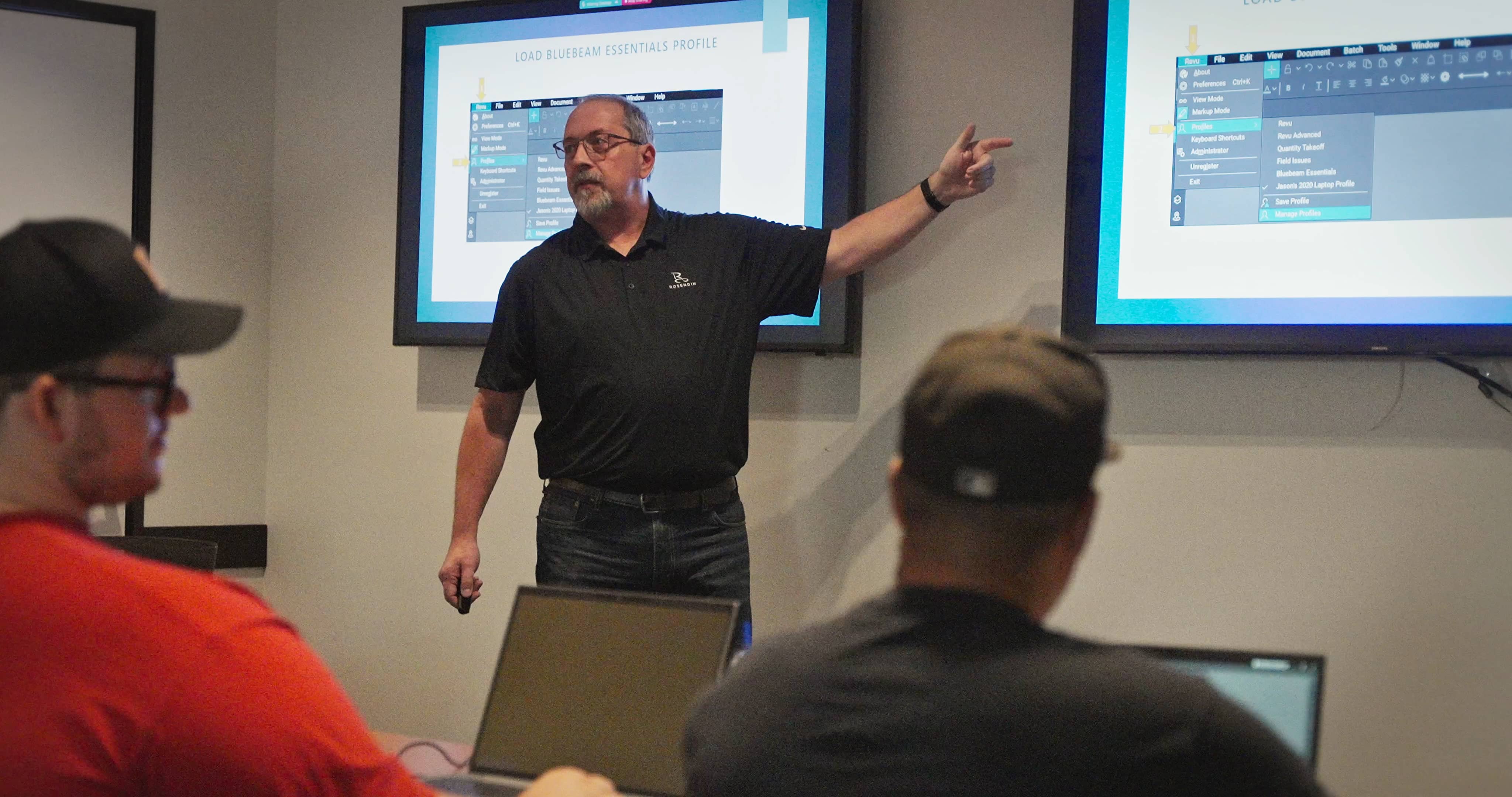
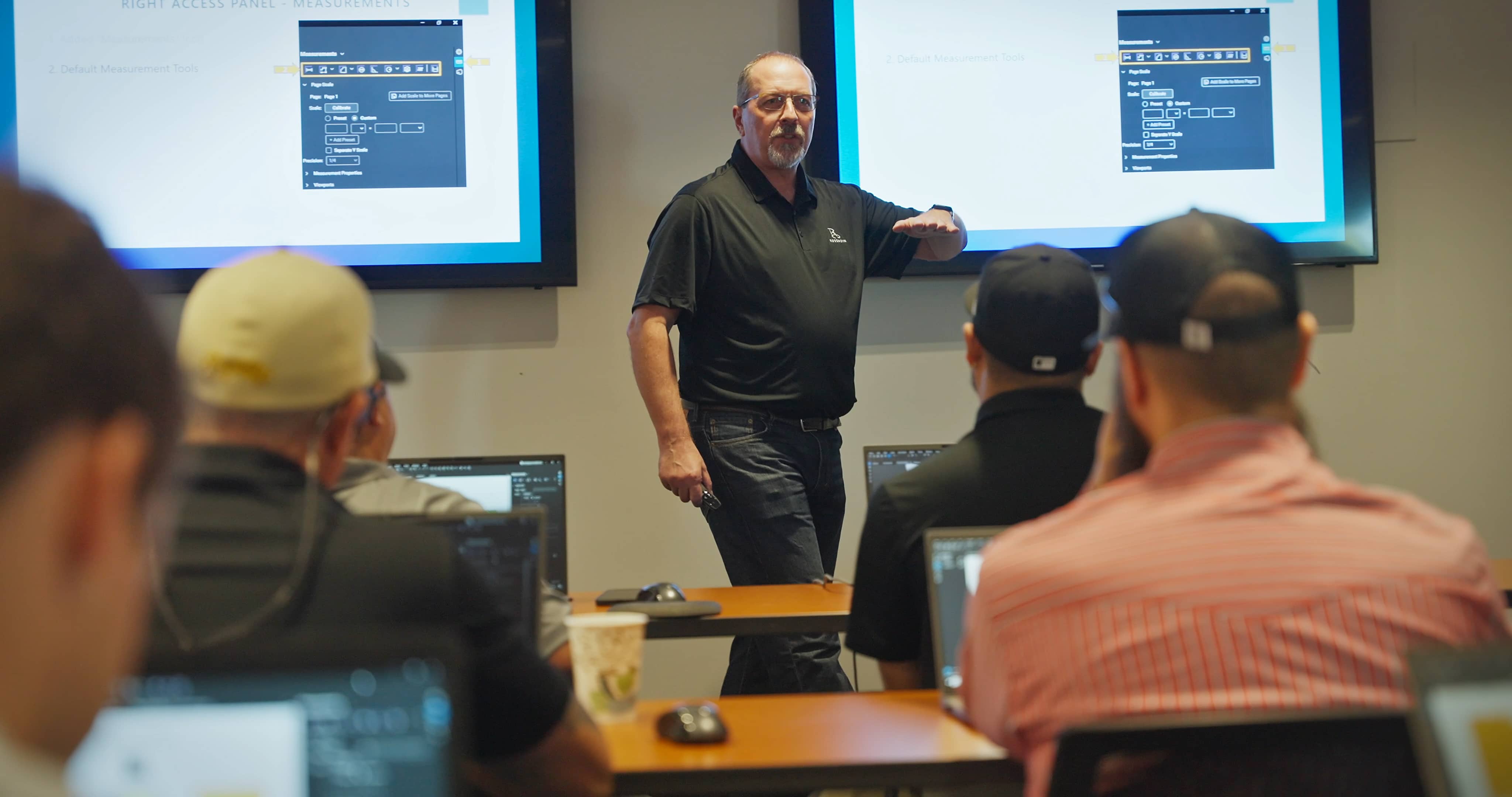
Today, McCarty teaches Rosendin field leaders two three-hour courses on Bluebeam in addition to his general leadership development training. The courses, which are all taught in person and include visual representations of electrical installations using Bluebeam tools, are specifically tailored to the electrical industry.
“When planning our work, efficiency, productivity, safety and effective communication remain top of mind as we strive to deliver predictable outcomes,” McCarty said. “And that’s what Bluebeam provides for us when we tap into its full potential.”

Upgrading Bluebeam Proficiency
“Bluebeam,” McCarty said, “is an endlessly capable piece of software. Its tools are so vast and the platform is so customizable,” he added, “that most of its users haven’t even scratched the surface of what it could do to make them more effective within their roles.”
“There’s a misconception [in the construction industry] that because someone has had Bluebeam on their computer for five years that they know how to use it,” McCarty said. Many Bluebeam users who might rank themselves as “proficient” often aren’t as skilled as they believe themselves to be, McCarty said.
McCarty identifies this as the Dunning-Kruger effect, whereby “people who have developed a baseline skill set, but have been doing similar tasks for a reasonable length of time, tend to rank themselves as having a higher skill set than they actually possess. It’s not due to pride or arrogance, it’s more often due to the fact that they just aren’t fully aware of the depth of knowledge required to be considered ‘proficient’ within a specific subject.”
This included McCarty, who found out the hard way both with his first unprepared experience as a project foreman and when he first started using Bluebeam for detailing. He struggled largely because he didn’t know what he didn’t know. Worse, no one was there to help train him through either experience.
As a result, McCarty said he’s structured his Bluebeam training with the goal of exposing field leaders to features and functionality within the software that go far beyond what appears on the surface. “I don’t expect attendees to memorize everything I show them, but instead, I want them to be able to recall at a later time,” he said. “Then they can contact me, and I can walk them through what they are trying to accomplish.”
Rosendin’s in-person Bluebeam courses have a maximum of 12 attendees. “The first thing I do is introduce them to what a Bluebeam profile is,” McCarty said. “Then, I have them import a profile specifically designed for the training. I also explain to them that we can customize this in the future, but for now we will focus on the basics.” The custom profiles he’s created are tailored for use by electrical field leaders, such as superintendents, general foremen, foremen, etc.
From there, McCarty identifies for his students 10 different markup tools in Bluebeam along with all the modifier keys. “Then, we get into properties,” he said. “The focus is on how users can modify markups, line styles, line widths, fill colors, hatch patterns, so on and so forth. I show them a quick trick where you can hold down the control key and pull away a duplicate markup. I also show them how to use the alignment and order functions.”
Another important topic covered is Bluebeam Studio, which is an integrated cloud-based document storage and retrieval platform available to all licensed Bluebeam users. Studio Projects and Sessions allow for real-time markup collaboration, which is essential in today’s digital-first world.
Fielding Success
To date, Rosendin field leaders value McCarty’s Bluebeam training. “I do surveys after every class and everyone is like, ‘Finally! Finally, someone is showing us exactly how to get to where we need to be,’” McCarty said. “They appreciate that the trainings are being developed and delivered by an electrician. They like that it’s for and from someone who came from the field—someone who cares about how they execute their work, and ultimately their success.”
McCarty said he thinks any company that is serious about using Bluebeam as part of its digital tool belt should have some form of intentional, dedicated and ongoing training around it. He added that whoever is in charge of leading the training must be both proficient using the software and passionate about sharing knowledge.
“It’s a big undertaking,” McCarty said of developing and delivering a formal Bluebeam training course. “What I hope comes through in this case study is that it encourages people and inspires them to think, ‘Oh, we’re waiting around for someone to just wave a magic wand over our heads when it comes to Bluebeam training. Maybe we should investigate this further and put more effort into it.”
Master Bluebeam’s tools and features with expert-led courses.