


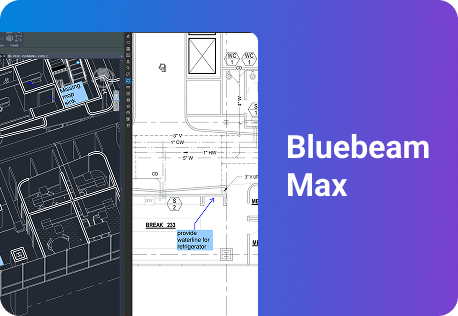




The truck is 20 meters long (about 66 feet), and it doesn’t fit.
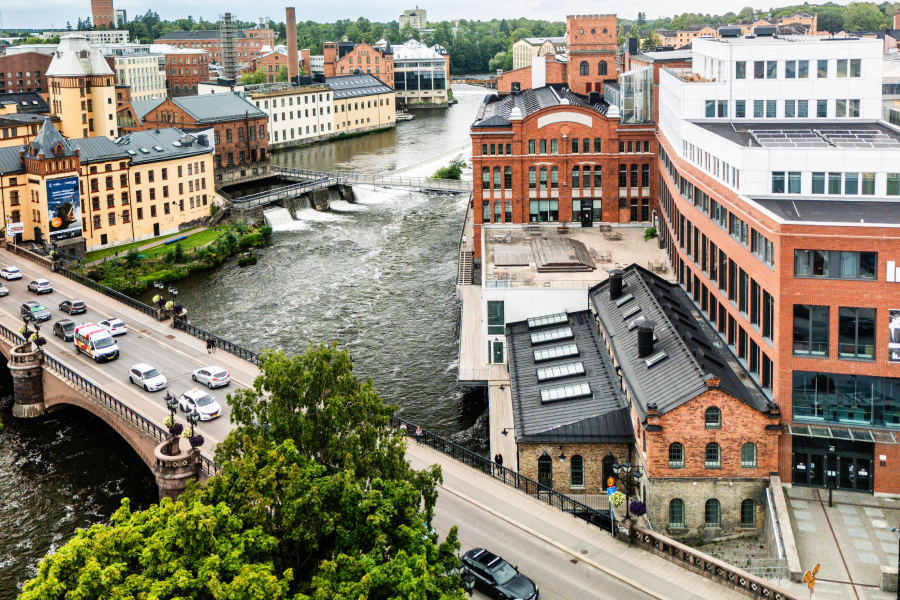
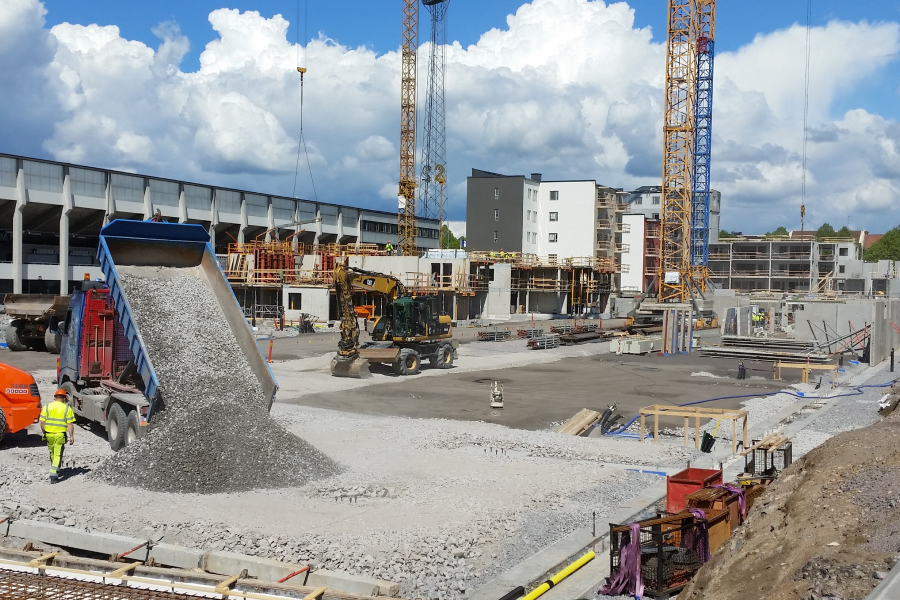
It’s the kind of problem second-year construction engineering students at Linköping University’s Norrköping campus work out the way professionals do: on the drawings. Their site is real — Kvarteret Publiken 1, a 266-apartment development NCC built a short walk from campus, wedged against a football arena, a busy road corridor and nearby homes and schools. A delivery route that sends heavy trucks past the homes, schools and arena next door has to be reconsidered. And the turning radius that flags the problem comes preloaded in their software, at true scale, from the contractor that really built the place.
This is the construction logistics lab, the hands-on conclusion to an introductory course that Martin Rudberg’s group launched in 2011, and an exercise the professor has run in Bluebeam since February 2017. The software the students work in is, by design, the one thing they barely have to think about.
“They don’t have to focus on the tool,” Rudberg said. “They can focus on learning logistics through the tool.”

The 3,000-Factory Problem
Rudberg holds a title that may be one of a kind: the L E Lundberg Endowed Chair in construction logistics and management. Ask him to define the field and he starts with a disclaimer. “Construction logistics is logistics employed in construction, but that’s not a good answer,” he said.
The better answer is what makes construction unlike nearly every industry he has studied — and he has studied plenty. Trained in industrial engineering and management at Linköping, with a doctorate in production economics, Rudberg spent his early career on planning problems in telecom, retail and manufacturing before a new research center drew him to construction in 2005. The difference, he found, is that a car factory stays put. A building gets built where it will be used.
“You have to move people, material and machinery to the site,” he said. “We build temporary factories to produce what we produce. Take one of the larger Scandinavian construction companies. They might have 3,000 projects running at the same time. That means 3,000 temporary factories and 3,000 temporary supply chains. Find another industry like that.”
It is also where the money leaks, and Rudberg’s group, now 13 researchers in a unit the university ranks as a leader in Sweden and Europe, has spent years quantifying how much. In their studies, supply-chain deliveries arrive correct in every respect (right product, quantity, quality, place, packing and paperwork) only about 38% of the time. On site, barely a fifth to a quarter of a worker’s time is value-adding. “If it had been easy, it would have been done,” he said. “I like challenges.”
He has had unusual freedom to chase this one. In 2009, a donation from the Lars Erik Lundberg Foundation for Research and Education endowed his professorship, financing it for an initial 10 years and then another 15, to roughly 2034. “It gave the stability to build something,” Rudberg said. “You could be long-term. You could recruit people.”

A Program Without a Legacy
Beginning in 2017, Rudberg ran a national test bed, The Connected Construction Site, that pulled in more than 60 organizations: major contractors including Skanska, NCC and Peab, global technology firms such as Microsoft and Autodesk, and a long tail of startups, suppliers and logistics firms. The message from industry was consistent. Graduates didn’t know enough about digitalization, from the internet of things (IoT) and digital twins to, eventually, artificial intelligence (AI).
Universities, he admits, are part of the problem. “In research we can be on the edge,” he said. “But getting research results into the education system is slow. We teach flexibility and awareness, but we’re not so keen on being flexible ourselves.”
Linköping had an advantage: no construction tradition to defend. “Innovation is our only tradition” is the motto in the university’s strategic plan, and it fits — the school is better known for health sciences, AI and hosting Sweden’s national supercomputing center than for construction. Nvidia CEO Jensen Huang holds an honorary doctorate there. So, when the industry asked for graduates fluent in digital construction, the school could build rather than renovate: a two-year master’s program in Digitalized Construction, now in roughly its fifth year, spanning programming, AI, IoT and smart cities.
But the digital push isn’t confined to the master’s program. Long before that program existed, Rudberg had been building digital tools into his teaching, and the clearest example sits in a compulsory second-year bachelor’s course, where he uses Bluebeam Revu to teach construction logistics.
One Real Project, Three Connected Plans
The Bluebeam lab arrives at the end of Rudberg’s introductory construction logistics course, once students have the theory. Then, in groups of four or five, they plan Kvarteret Publiken 1 in three connected steps.
First: get everything to the site. Students plot how material, machinery and people will travel from suppliers to the project, checking roads, bridges and truck access. Second: plan the site itself (storage areas, crane and construction lift placement, the flow of people and material) on the project’s actual drawings, imported into Bluebeam. Third: plan the logistics flows inside the building, floor by floor. Then comes the hard part: making all three plans agree with one another.
“Logistics is not just about moving materials. It is about creating the conditions for production to run smoothly.”
Molly Lundgren
Production Engineer
Skanska
The realism is engineered. NCC, one of Sweden’s largest contractors, opens the lab with a guest lecture (effectively, “here’s how we do everything Martin just taught you, but in Bluebeam”) and hands students the company’s own templates and Tool Chests, real-world dimensions already scaled in. “If the truck is 20 meters, can it actually fit into the site? You get that automatically,” Rudberg said. Christian Gren of Bluebeam follows with a brief technical orientation. From there, students collaborate in Studio Sessions, working the same documents from anywhere.
And that is roughly all the software training anyone needs. “Honestly, you could do this on paper, or in another software,” Rudberg said. “But the setup time to get students going in Bluebeam is really short.” That short setup time is the point, not a knock: it is what lets the logistics, rather than the software, fill the class. Over the years of running the lab, he added, students have asked very few questions about the tool itself.
Rudberg has tried alternatives, including some with flashier 3D interfaces. They proved harder to get under the hood of, he said. There is a market logic, too: in Rudberg’s experience (he is careful to note he hasn’t seen a formal market study) Bluebeam is common enough in Sweden that students are more likely to meet it on the job than any other tool. A decade of licensing that simply works hasn’t hurt either. “I send an email somewhere in the U.S., and it just works,” Rudberg said. The hours not spent getting the lab running, he added, go into improving the assignment itself.
The course ends with a seminar that is half critique, half reckoning. Rudberg pulls up selected groups’ plans, the class compares approaches, and then he lays the student work against how NCC ultimately handled logistics on the real project. The students, more often than not, come out looking good. He is quick to absolve the contractor: the planner responsible on that job, he notes, was one of his own former students. “So I am to blame,” he said.
From the Lab to the Field
Rudberg is the first to admit he doesn’t have placement metrics tied to the lab, but the signal from returning graduates is consistent. “They remember the labs much more than my theoretical lectures,” he said. Some have called after landing jobs to report that their new employer runs on Bluebeam, and that they were glad to have already used it. Others land at an employer that runs on something else, and the fluency still transfers. “If you know one system, it’s easier to learn the second, or the third,” he said. “It’s about understanding the workflow: what the systems can do and what they can’t.”
Sofia Jansson is a case in point. She took the course in spring 2024 and returned the next year as a teaching assistant. What resonated most for her was the final seminar, where the class pulled up their Bluebeam plans side by side and compared approaches. “It was fascinating to see how the same task could be solved in so many different ways,” she said. Building the site layout from the Tool Chest elements, she added, gave her a real feel for scale: how much room a crane, a container or a staging area takes, and how that reshapes the whole site.
The realism landed again on the job. During a summer position, Jansson watched a colleague build site layout plans, known in Sweden as APD plans, and understood exactly what the work involved. “Looking back, the work we produced as students was of a very high standard,” she said, “and would have been more than sufficient for a real-world project.” Her advice to anyone weighing the program is practical: you will meet these plans somewhere in a construction career, and getting familiar with a tool like Bluebeam while still studying “can be a significant advantage when entering the workforce.”
“Looking back, the work we produced as students was of a very high standard, and would have been more than sufficient for a real-world project.”
Sofia Jansson
Teaching Assistant
Linköping University
Molly Lundgren took the same course in spring 2024, went on to finish Linköping’s master’s in Digitalized Construction, and is now a production engineer at Skanska, one of the contractors that had sat in Rudberg’s test bed. What struck her about the lab was how little it resembled a typical assignment. “Instead of only discussing logistics concepts in theory, we had to apply them directly to a construction project using actual drawings,” she said. The concepts clicked, she added, when the class began weighing how site-layout choices shaped both efficiency and safety. “Logistics is not just about moving materials,” Lundgren said. “It is about creating the conditions for production to run smoothly.”
Today that is her job. Lundgren uses Bluebeam daily at Skanska to review drawings, pull measurements the drawings don’t show, prepare work instructions and build site logistics plans, the same APD plans the lab had her practice. “The tasks I perform today are very similar to the exercises we worked on during the Bluebeam logistics lab,” she said. Because she had already worked through site layouts and material flows as a student, the real thing felt familiar. Her advice to students echoes the lab’s whole design: a solid software introduction up front, she said, let her “focus on solving the logistics challenges rather than spending all our time trying to figure out how the software worked.”

Building What’s Next
Nearly a decade in, the lab keeps evolving, and the part that changes is the teaching. The tooling holds steady. Recent iterations added material-quantity calculations and more raw project data from NCC, and the comparison seminar has grown more interactive, with groups pairing up at adjacent screens to compare and merge plans. “When we change the course, the software hasn’t been an issue,” Rudberg said. “I can keep developing the assignment and be confident the software will just work. That’s how software should be.”
Next, he wants Bluebeam in more of the curriculum. Today it appears in just that one compulsory second-year course; extending it into the master’s program and other bachelor courses is an active discussion, with no decision yet. He is making the case to colleagues and curriculum planners, and the wider sector is already leaning that way. BEAst, the Swedish construction sector’s e-business standards body, has built a standardized design-review method around Bluebeam, using Studio Sessions and other capabilities in Revu to run structured, multi-party reviews with set comment statuses, color codes, approvals and archiving. His argument is practical: if the student licenses are there, why not use them to their full potential?
Rudberg’s advice for educators elsewhere is simpler still, and characteristically generous. “Call me,” he said. He has the materials, the case, a handbook he’s happy to share. But the principle costs nothing: “Have a real case. Work with a good software company, work with a construction company. And if possible, take the students to the site they’re actually planning.”
Because that is the whole trick — the reason a truck that doesn’t fit teaches more than any lecture could. “The more real it gets,” Rudberg said, “the more the students learn.”
Interested in bringing Bluebeam to your university? Learn more about our academic program.