





Musselman & Hall Contractors LLC, based in Overland Park, Kansas, has spearheaded construction projects throughout the Midwest focused on concrete, asphalt and railroad for the better part of the past century. Employee owned and built on long-lasting customer relationships, the company has in the past 20 years broadened its work beyond its historic specialties and government projects to include more general contracting to a wider customer base.
Like most seasoned construction firms, Musselman & Hall has incorporated industry technology as it has evolved over the years, embracing tools that allow the firm to remain on the cutting edge of speed, precision and efficiency—critical tenets for any construction outfit.
“We’ve always aimed to be an organization that is ahead of the changes with technology and things in the marketplace. Sometimes we get behind, but we always strive to be ahead and give our people the best tools to do their jobs,” said Kyle VanSlyke, Musselman & Hall’s chief operating officer and 25-year company veteran.
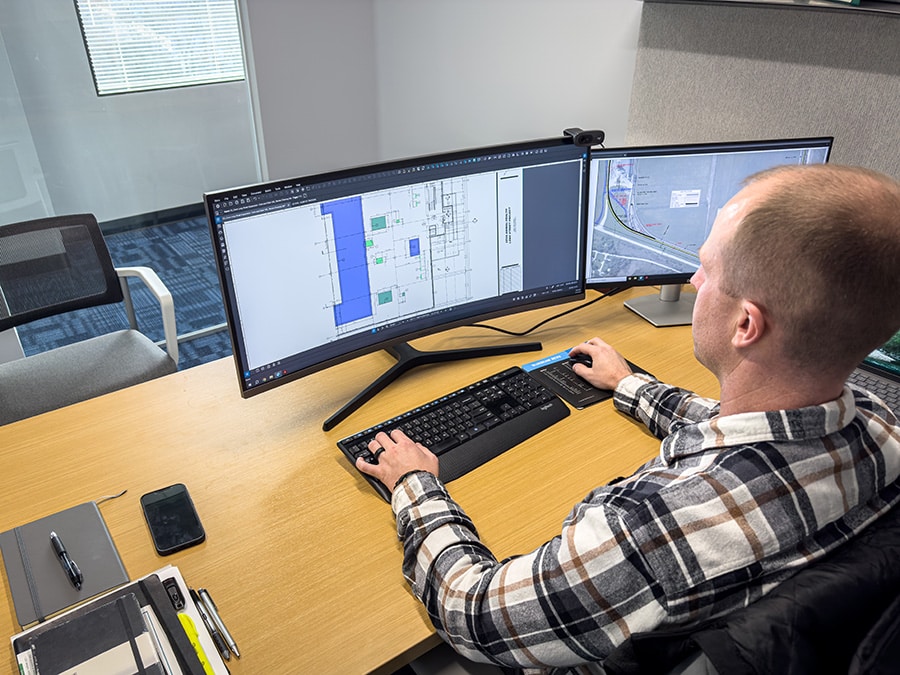
But in 2021, the company found itself at a crossroads with one of its technology tools, particularly in its pre-construction group responsible for conducting project acquisition and building cost estimates. At the time, the pre-construction team was using takeoff software for calculating estimates that was reaching its limit. “The files were in a specific OST format, and our construction was moving to PDFs,” said Christopher Leheney, the company’s pre-construction manager.
OST is a file type that would need to be converted to PDF after takeoffs were complete, adding a layer of work that made it difficult to use in an industry increasingly centered around PDF plan documents. If the company received documents in PDF, for instance, it would have to convert to OST to conduct takeoff work before converting it back to PDF for the client to review.
The team wanted something that could work with PDF natively, allowing for markups and other takeoff functions to happen seamlessly in one document type, thus eliminating that extra layer of work.
After a thorough search, Musselman & Hall quickly settled on Bluebeam as the solution. “We had several [tools] on our list, maybe four or five, and as it came down to studying and refining and trying to figure out what would be the best fit for us, Bluebeam elevated to the short list,” Leheney said.
Picking Bluebeam
Settling on Bluebeam for its quantity takeoff capability was ultimately an easy choice. “We did the circles of the pros and cons, weighing here’s the price of this one vs. that one; here’s what this one gives us that the other would not,” Leheney said. Bluebeam checked all of the company’s boxes.
Helping Musselman & Hall decide on Bluebeam as its new takeoff software solution was the fact that several of its newer employees had used it at other stops in their careers. “It was really good to have them come in with a little bit of Bluebeam experience, see what we were using and then they could help us understand the potential change in moving to Bluebeam while also seeing what we were using,” VanSlyke added. “It helped put a framework on the gains that we would get by switching.”
“If I were to put hours to a month based on the output of bids we do, I would say you’re probably getting at least 3-4 hours a week per estimator per bid and you’re probably getting a net total of 60 hours a month from an estimator.”
Christopher Leheney
Pre-Construction Manager
Musselman & Hall
Putting Bluebeam into place for around 20-30 estimators wasn’t going to happen overnight. Making the adoption and implementation intentional and strategic meant partnering with the company’s IT department as well as gaining initial feedback from the eventual end users on what would make the transition easiest for them, including getting a feel for each person’s preferred learning style.
“That started to build out our plan,” Leheney said, “which was then presented several times over four to eight weeks where we made revisions and made sure we had thought of every avenue and ensure no one would fall behind in the implementation process.”
As for initial training, Leheney said the idea was to err on the side of a lot of training. Whereas some firms may opt to train on the basics and build over time, Leheney said they chose the opposite tactic. “We wanted to over-train and ensure that everyone was beyond understanding,” he said. “It’s so easy when you get a software to say, ‘Hey, let’s do the hour. OK, you’re good to go.’ And then you’re forgetting things or not doing that diligence to keep growing.”
Another reason the Musselman & Hall team decided to go hard with the initial training: it planned to use Bluebeam beyond the pre-construction and estimation group to include project management and other essential functions as well.
“It was important that we weren’t just shifting from our previous takeoff software into Bluebeam for just takeoff purposes,” VanSlyke said. “There were a lot of reasons that we were going to be able to use Bluebeam within the organization, so we wanted to make sure that we had a good path for the change management so that all team members would be able to use the software to help them in their roles.”
Making the Transition
While training and eventually making the transition to Bluebeam, the pre-construction group maintained use of its previous software tool for takeoffs. “There were some timelines and projects that were going to overlap and interact before we could make the switch holistically,” Leheney said. Still, he had an end date in mind to prevent any excuses to fall backward in the training. “We wanted to ensure that we were proficient with Bluebeam before cutting off the old software,” Leheney said.
As the training went on, it became clear that Bluebeam was even more powerful than the team initially thought. “There’s just so much to Bluebeam,” Leheney said. As more training on the basics continued, the group continued to discover new and exciting layers to the software.
“We knew that, OK, there’s a lot there [in Bluebeam], but as you’re training, you’re asking questions and digging deeper into subcategories of markups, takeoffs, the collaboration, all of that,” Leheney said. “People caught on pretty quick to the basics, but trying to use the program to its fullest capabilities took some time.”
All told, Leheney said it took “a few months” to get the team mostly operational on Bluebeam. And by the end of 2022, the company was able to completely offload the previous takeoff software in favor of Bluebeam. “It really only took a couple of months to get rolling with Bluebeam, but for a complete cut point to go from one software to the other, it was pretty close to the end of the fiscal year, just so we could get through the work cycle acquisition,” VanSlyke said.
Discovering Benefits
The benefits of using Bluebeam became evident almost immediately. Besides Bluebeam’s superior takeoff tools and capability, which allowed estimators to complete their work faster and more accurately, some of the biggest improvements came with the company’s project managers.
“Project managers discovered this thing called RFI Format where there’s already pre-built RFIs within Bluebeam that we didn’t know we had, and we had no process in our company for that,” Leheney said. “So that was a template and a structure that helped project managers almost immediately.”
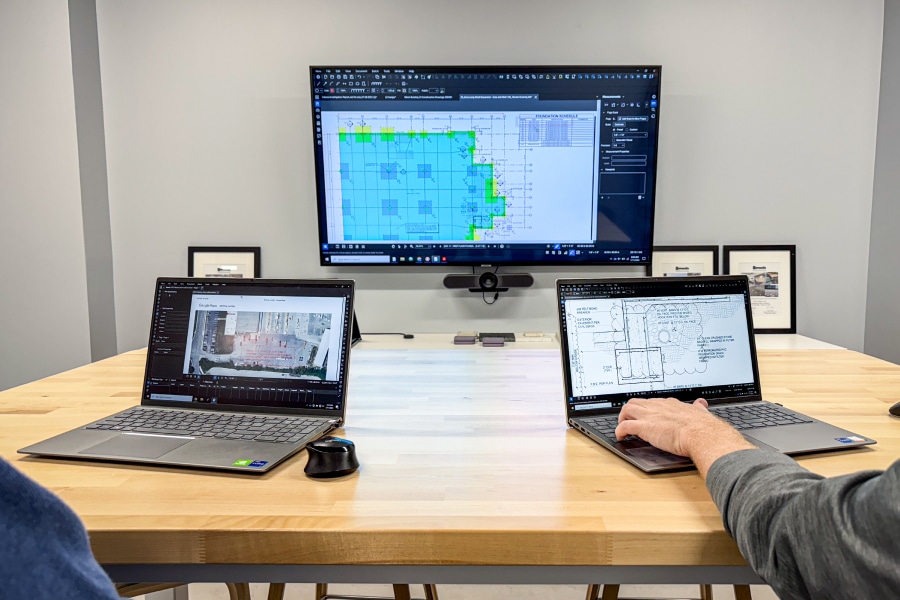
Bluebeam Studio, which allows for real-time document review collaboration, was another software feature the team discovered and took a liking to. Leheney said it has begun to use Studio Sessions for real-time document collaboration on some larger projects.
Although the company hasn’t formally calculated time savings in its workflows since switching to Bluebeam, Leheney said the boost in efficiency has been evident. Chief among the new efficiencies: being able to be more collaborative and faster when it comes to communicating document changes with customers. “When changes are needed or [customers] have specific needs, we’re able to address those quicker with Bluebeam,” he said.
“If I were to really try to put hours to a month based on the output of bids we do,” Leheney continued, “I would say you’re probably saving at least three to four hours a week per estimator per bid. I mean, that could be 60 hours a month, three to four hours a week per individual, and you’re probably getting a net total of 60 hours a month from an estimator.”
Musselman & Hall’s customers have noticed. “We’ve been told that we’re kind of ‘next level’ compared to competition as far as having a dialogue back and forth on cost changes or just overall project details,” Leheney said.
Perhaps the biggest benefits from switching to Bluebeam have been internal, Leheney added. Since the employees own the company, they inherently have an interest in its success, and a tool like Bluebeam has made them more engaged and excited about pursuing that success every day.
“Everyone is invested,” Leheney said. “Everyone wants to see the company succeed and thrive. And with a program like Bluebeam, you get more collaboration, and I think that’s a cool thing to see when everyone has the same goal in mind.”