

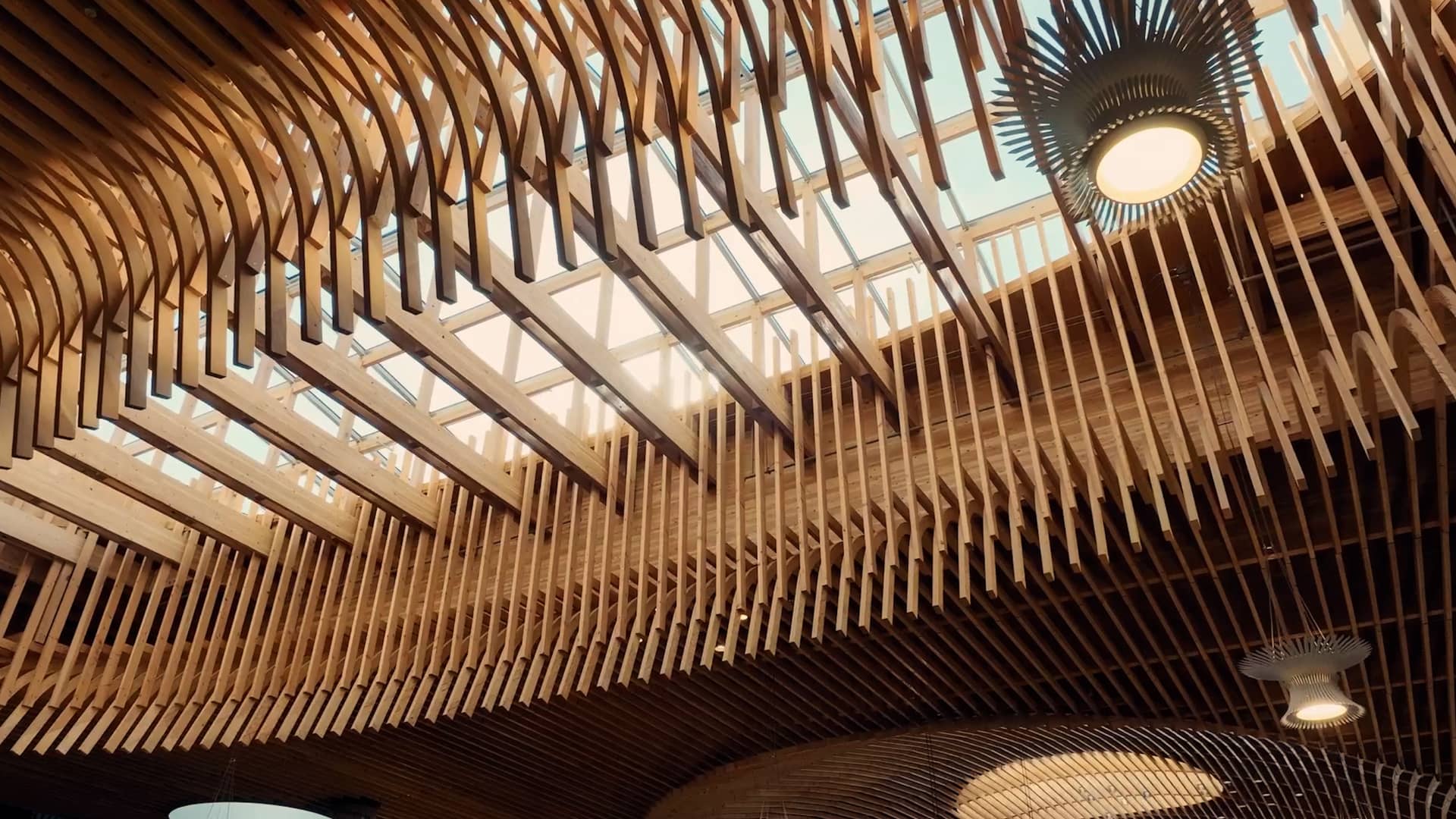





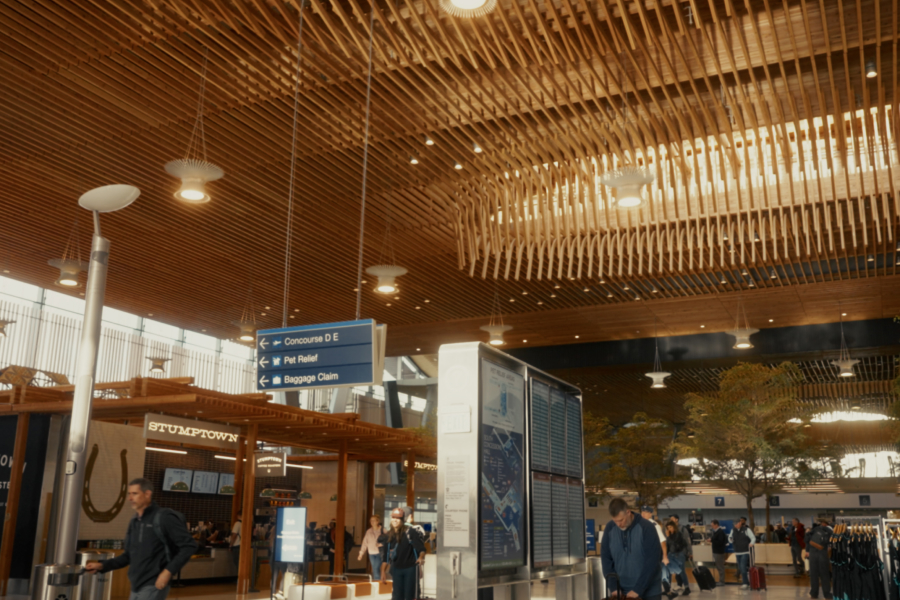
When travelers walk into Portland International Airport’s new main terminal, the first thing they see is a nine-acre timber canopy soaring over a space nearly twice the size of the old lobby.
The roof — engineered to ride out a magnitude 9.0 earthquake and prefabricated in giant segments before being wheeled into place at night — spans what used to be a patchwork of buildings. Now it frames a civic space that is at once vast and warm, filled with daylight, trees and the scent of Pacific Northwest wood.
For the Port of Portland, the Terminal Core Redevelopment was more than an expansion. At $2 billion and 1 million square feet, it was the largest public works project in Oregon history and the centerpiece of the decade-long PDX Next program.
The goal: prepare the airport to serve 35 million passengers annually by 2045, while preserving the local character that made PDX a perennial favorite among U.S. travelers.
For ZGF Architects, the design lead, the stakes were both professional and personal. The firm has shaped PDX for decades, and this time it was asked to reimagine the airport’s “living room” without losing its soul.
“Everybody loves Portland International Airport,” said Nat Slayton, principal and senior technical designer at ZGF. “It’s a place that belongs to the community. That was the challenge: how do you evolve it while making it something people will love just as much as the original?”
The task was immense: double the capacity of the terminal, meet seismic standards, integrate biophilic design and never shut the airport down. Then came COVID-19. Just as documentation hit full stride, the pandemic forced the largest design team in state history to abandon in-person workflows overnight.
“All of that scale and inertia collided with COVID,” Slayton recalled. Faced with the risk of slipping timelines on Oregon’s most ambitious infrastructure project, the team needed a new foundation for collaboration.
They found it in Bluebeam.
Reimagining a City’s Gateway
The technical hurdles of the main terminal at PDX were immense. The new nine-acre roof was prefabricated in 18 giant cassettes, each the size of a football field. Those sections had to be rolled across the tarmac and slid into place at night, while ticketing, security and baggage operations continued below.
Complex phasing plans meant every move had to be sequenced precisely, with live construction happening around tens of thousands of daily travelers.
The project also set records before construction even began. It generated the largest permit set in Oregon history, with nearly 6,000 sheets under active coordination. The design team itself spanned multiple disciplines, time zones and stakeholder groups, from engineers and contractors to the Port of Portland and airline partners.
Then came the disruption no one had planned for in COVID-19, which forced the team to abandon the “war rooms” where drawings once covered every wall. “It was the largest project the state had ever seen — and then COVID hit at the worst possible moment,” Slayton said. Suddenly, hundreds of architects, engineers and consultants were working from their living rooms, responsible for delivering Oregon’s most ambitious civic project on schedule.
Bluebeam as a Digital Backbone
Before the pandemic, collaboration at ZGF meant gathering in person where walls were plastered with drawings and teams worked shoulder to shoulder on markups. That physical proximity was critical for a project as complex as PDX. “We had entire walls just covered in drawings,” recalled Michael Adams, BIM manager at ZGF. “You’d bring people into the room, talk through a problem and mark it up together.”
“[Bluebeam] quickly turned into my front door.”
Michael Adams
BIM Manager
ZGF Architects
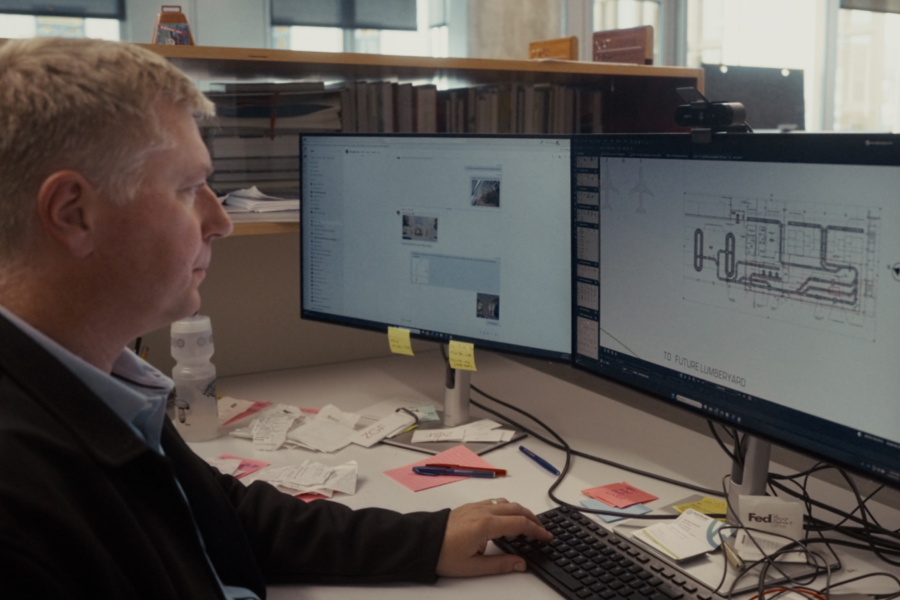
With COVID-19, the team had to reinvent its workflow overnight. Bluebeam quickly filled the void. “It quickly turned into my front door,” Adams said of Bluebeam. Instead of pinning paper sheets to walls, teams uploaded drawing sets into Studio Sessions, where dozens of architects, engineers and consultants could mark up in real time from home offices across the country. The shift was immediate and transformative: what had once required everyone in the same room now happened virtually, without slowing the project.
To make the process scalable, ZGF crowdsourced toolsets from across disciplines. Color-coding systems and standardized markups created a shared visual language so structural engineers in one time zone and architects in another could read and respond to each other’s work without confusion. Status tracking layered accountability onto the process, showing briefly which comments had been addressed and which remained open.
Bluebeam’s Sets feature became indispensable. Sets allowed the team to link, sort and search documents as if they were working from one master drawing. Slip Sheeting ensured new revisions replaced old ones cleanly, reducing version control errors that might otherwise have slowed coordination.
Quality control also took on new life. Studio Sessions enabled what Slayton described as “crowdsourced reviews,” multiplying the number of eyes on each document. Younger staff members gained visibility into senior reviewers’ comments, turning each markup session into an impromptu mentorship opportunity.
“You could see how experienced people thought through a problem,” said ZGF project architect Christian Schoewe. “That kind of access wouldn’t have been possible in the old room setup.”
The workflows extended beyond design. Exportable markup lists doubled as meeting agendas with contractors and the Port of Portland, while live status updates gave owners confidence that no issue was falling through the cracks.
By the end of the first year, Bluebeam was no longer just a drawing tool. It had become the project’s digital backbone — a command center that kept Oregon’s largest public works project on track during one of the most disruptive periods in modern history.
Efficiency, Accuracy and Accountability
Bluebeam’s role at PDX went far beyond digitizing redlines. It created measurable efficiencies, reduced costly errors and gave every stakeholder — from junior architects to contractors and the Port of Portland — a clearer view of the project’s progress.
- Accelerated reviews: Studio Sessions turned what had once been weekslong review cycles into days, as dozens of stakeholders could simultaneously comment on the same set of drawings.
- Fewer coordination errors: Overlay and comparison tools helped flag discrepancies across nearly 6,000 sheets before they became field issues. By resolving conflicts early, the team prevented expensive rework and kept construction phasing on track.
- Transparency and accountability: Status tracking and markup history provided a living log of every comment and resolution. Owners and contractors gained confidence knowing they were working from the most current information.
- Institutional memory: Years into the project, Schoewe used Bluebeam’s archive to retrieve a markup that justified a critical roof detail. The digital “paper trail” prevented a costly omission and showed the long-term value of centralized documentation.
- Mentorship at scale: Shared visibility into senior reviewers’ markups allowed younger staff to shadow decision-making in real time. “You could see how experienced people thought through a problem,” Schoewe explained — a form of apprenticeship that would have been impossible under pre-COVID workflows.
In the end, Bluebeam didn’t just speed up reviews but built a culture of accountability and collaboration that carried the project through disruption, setting a new benchmark for digital delivery on complex civic infrastructure.
Pride and Legacy
For all its technical complexity, the PDX new main terminal was never just about engineering or logistics. It was about creating a civic space that Oregonians could be proud of — and one that travelers would remember long after they’d left Portland.
Schoewe still recalls the first time he walked through the completed ticketing hall and saw passengers looking up at the sweeping timber roof.
“I still get a kick out of seeing people’s reactions,” he said. “You can almost read their lips: How did they do that with all that wood?”
The awe reinforced what the design team had hoped: that the building itself would be an experience, not just a way station.
For Slayton, pride came from the people behind the project. “This was made by the talents and skills of the people they live with in their state,” he said. From foresters supplying Douglas fir within 300 miles, to Timberlab crews assembling the massive roof panels, to local artists filling the concourses with public art, the project was built by Oregonians, for Oregonians.
That connection between local labor and civic identity was as important as the architectural achievement.
Adams saw the mission more simply: it was about the passenger. “That was the mission,” he said. Every design decision — from wider security checkpoints to abundant daylight and greenery — was measured against its ability to make travel less stressful.
The impact of that biophilic design is already evident. With 72 full-size trees, filtered daylight and open green spaces beneath the vast timber canopy, travelers often describe a calming effect as soon as they enter.
“The stress just melted away,” Schoewe observed, echoing the neuroscientists and environmental psychologists who advised on the design.
Ultimately, the project left the team with more than drawings and schedules. It left them with pride in a civic landmark that reflects Portland’s values, honors its people and gives every traveler — from daily commuters to first-time visitors — a reason to pause, look up and feel at home.
A Model for Digital Delivery
The workflows ZGF built at PDX didn’t disappear once the immediate crisis passed. Bluebeam carried the team from design through permitting and into construction, becoming the connective tissue across disciplines and project phases.
What began as a workaround during COVID matured into a lasting digital framework that reshaped how the firm approaches large-scale infrastructure.
Some of the innovations developed on the fly are now embedded in ZGF’s practice. Custom automation tools for digital stamping and issuing pull sheets, first created to keep pace with the main terminal’s relentless schedule, remain in use on other projects.
The discipline-specific toolsets and color-coded markup standards refined at PDX have since become templates for cross-office collaboration. In many ways, the airport project served as a testbed for workflows that are now standard practice.
The implications extend beyond one airport. PDX showed how digital tools can support phased construction at a live facility, streamline coordination across the largest design team in a state’s history and preserve institutional knowledge for years.
As civic infrastructure projects grow more ambitious, the PDX experience offers a model: with the right digital backbone, teams can deliver complex public works without losing accuracy, accountability or human connection.
In Portland, the outcome speaks for itself. Digital precision helped build a terminal worthy of its reputation as “America’s favorite airport” — a civic landmark that blends innovation, resilience and a deep sense of place.