


ZGF Architects
PDX Reimagined: How a Digital Backbone Powered America’s Most Ambitious Airport Project
A new way to supercharge Revu with AI.

The Complete Guide to Construction Takeoffs in 2026


Construction Document Management Software in 2026: How to Choose
How to evaluate the options, match a platform to your team and
avoid buying the wrong thing.

By the time most teams shop for construction document management software, they already have a system. It just isn’t working.
Maybe it’s a shared drive where the current drawing set and three outdated ones sit in the same folder. Maybe it’s email, where the latest revision is buried under 40 replies. Maybe it’s a platform someone bought two years ago that the field never adopted. The symptom is the same: people are building off the wrong information, and nobody’s sure which version is right.
The cost of choosing wrong is real. A platform the field won’t use doesn’t just waste its license fee; it sends people back to email and printouts, recreating the exact problem it was bought to solve. That problem is expensive: poor data and miscommunication drive nearly half of all construction rework. Switching tools a year later means retraining, migration and the credibility hit of a second rollout. The goal isn’t the most powerful tool — it’s the right one, adopted.
In either case, it’s a crowded category. Construction management software is roughly a $10.6 billion market in 2025, growing close to 9% a year, and dozens of tools claim to solve the document problem. They don’t all mean the same thing by it.
This guide is about choosing well: what to evaluate, how the needs change by role, how the major platforms ultimately differ and where Bluebeam fits. If you’re still mapping the problem itself, start with our guide to document management for construction.
What to look for in construction document management software

Start with criteria, not a demo. Every vendor will show you a polished workflow; the question is whether it survives contact with your projects. Six things separate software that helps from software that sits unused.
- Mobile and offline access. The field has to reach the current set on any device, including in a trailer with no signal. If the current drawings only live on an office desktop, you’ve digitized the office and stranded the field.
- Markup and redline tools. Crews and reviewers need to annotate, measure and redline directly on the document and reuse standardized markups so a takeoff or an RFI looks the same across the team.
- Version control and audit trail. Look for slip sheeting, document comparison and a complete revision history with attribution. This is the difference between one trusted set and a folder full of maybes.
- Permission and role management. The right people edit; everyone else views. Role-based access keeps subs, owners and reviewers in the same environment without overwriting each other.
- Integrations. Document management software for contractors rarely lives alone. It should connect to the PM platforms, design tools and ERP systems you already run so documents flow instead of getting re-entered.
- Ease of use for the field. The most capable platform is worthless if a foreman won’t open it. Adoption, not feature count, determines whether the investment pays off.
Weight these against your own work before you watch a single demo. A tool that nails five and fails the sixth is one your team will abandon.
Key use cases by role
“Best” depends entirely on who’s using it. The platform that’s ideal for a 500-person GC can be overkill for a three-person trade shop.
General contractors. The job is coordination, keeping dozens of subs on one current set and moving submittals through review without losing track. GCs need strong version control, document collaboration across organizations and a defensible audit trail. When a sub builds off a superseded sheet, the GC owns the rework, which is why one synchronized set across every trade is the whole game.

Specialty and trade contractors. The priority is the field: instant access to current drawings, fast markup and the ability to create or answer RFIs from the site. Tools that work on mobile without a desktop license matter most here. A trade foreman shouldn’t need a laptop and a VPN to check whether a dimension changed overnight.
Small contractors. Simplicity, cost and a mobile-first workflow beat enterprise breadth. A focused document and markup tool usually serves them better than a heavyweight project-management platform they’ll use 10% of. Owner-operators want to open the app, find the current drawing and get back to work.
Project engineers and managers. Document organization, a clean audit trail and the ability to assemble closeout packages — as-builts and O&M manuals — without a scramble at the end of the job. The audit trail that felt like overhead during construction becomes the most valuable asset they own the moment a claim lands.
A framework for comparing construction document management software
Don’t score vendors against each other. Score each one against your workflow. These six dimensions are where document tools really diverge; use them as the spine of any demo or trial.
| Capability | What to look for | Why it matters |
| Markup & redline | Annotate, measure and redline on the PDF; reusable tool sets; markups that carry across revisions | Field questions and clarifications get captured in context, on the document everyone sees |
| Mobile & offline | Current set reachable on phone or tablet; works without signal; syncs when back online | The field builds off the latest set, not last week’s print |
| Version control & audit trail | Slip sheeting, document comparison and a complete, attributable revision history | One current set everyone trusts — and a defensible record when there’s a dispute |
| Collaboration | Real-time shared environment; check-in/out; assigned markups and status tracking | Office and field work from one source of truth instead of merging copies |
| Integrations | Connects to PM platforms, design tools and ERP | Documents flow between systems instead of being re-entered or siloed |
| Ease of use | Field staff can adopt it with minimal training | Adoption is the difference between a tool that’s bought and a tool that’s used |
Two categories get conflated in this market. Broad construction-management platforms — Procore, Autodesk Construction Cloud — cover scheduling, financials and project management, with document management as one module. Document-and-markup specialists like Bluebeam go deep on the drawing itself: markup, comparison, version control and field collaboration. They’re not strictly either/or, as many teams run a specialist for drawing work inside a platform that runs the rest of the project.
However you shortlist, test on real work. Load an actual drawing set, run it through a revision cycle and put it in the hands of the people who’ll use it in the field, not just the buyer. The platform that demos beautifully in a conference room and stalls in a trailer is the most expensive mistake in this category. A two-week pilot on a live project tells you more than any feature matrix.
How Bluebeam approaches construction document management

Bluebeam is built around the document most likely to cause trouble: the drawing. More than 4 million AEC professionals use Bluebeam Revu to mark up, measure and manage project documents, and its strengths line up with the criteria above.
Ease of use. Reviewers and third-party analysts consistently rank Bluebeam as easy to adopt, which is why field teams use it instead of routing around it.
Markup and drawing control. Markups live as both a visible annotation and a data record, and tools like Sets, Compare Documents, Overlay and automatic slip sheeting keep an unlimited set organized and current as revisions land.
Real-time collaboration. Studio Sessions let multiple reviewers mark up the same document at once, while Studio Projects keeps the shared set with check-in/out and a full activity record — one source of truth, so office and field stop merging copies.
Mobile field access. Through Bluebeam Cloud, teams reach the current set, mark up and handle RFIs from web or iOS, then sync back to the desktop.
Integrations. Bluebeam connects to the PM platforms and design tools teams already run, so drawings and markups move between systems instead of being re-keyed into each one.
The payoff shows up in the field. Mechwest grew its team tenfold after going digital with Bluebeam; Premier Mechanical saved $70,000 digitizing project delivery; and on a live project, McCarthy used Bluebeam to slip-sheet revised drawings on a project that generated thousands of documents.
Others measure it in paper alone: Ribuna AG cut paper use 20% to 50%, and Turner Construction saved 73% on paper costs digitizing project delivery with Bluebeam.
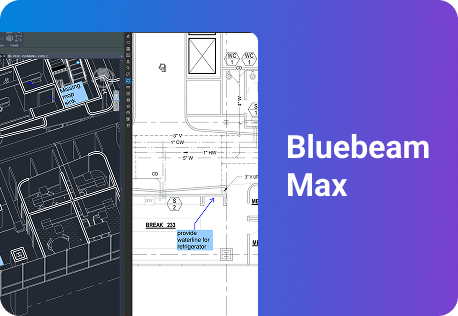
The AI tier. For teams ready to push further, Bluebeam Max is a premium, AI-powered plan that connects Revu to Anthropic’s Claude through the Model Context Protocol. It adds AI-assisted drawing review — Smart Review scans documents for design issues, scope gaps and discrepancies — along with Stitching, which combines sheets into one continuous view, and Connected Studio Sessions with Revit that link PDF markups to the matching spot in the 3D model.
See how it works on your own drawings — start a free trial or book a demo.
Common questions when evaluating software
A few questions come up in nearly every evaluation usually about field use, version control and how Bluebeam stacks up against the bigger platforms. Direct answers below.
Frequently asked questions
What’s the best construction document management software for field teams?
The best field tool is the one the field will actually open: mobile, offline-capable and fast to mark up. Prioritize instant access to the current set on a phone or tablet over back-office features. Bluebeam pairs desktop Revu with Bluebeam Cloud so crews can review and redline drawings on-site, then sync. Test it the way the field will use it: on a phone, in a low-signal corner of the site, on a real sheet.
What’s the best cloud-based construction document collaboration platform for general contractors?
General contractors need construction document collaboration software that keeps many subcontractors on one current set, with submittal workflows and a shared environment. Bluebeam Studio provides that real-time shared workspace; broader platforms add full project management on top. Many GCs run both, with Bluebeam handling the drawing and markup work.
What’s the best construction document management software for small contractors?
Smaller firms are usually better served by a focused, affordable, mobile-first document and markup tool than by an enterprise project-management suite they’ll barely use. Look for low setup cost and a short learning curve. The best construction document management software for a small contractor is the one the whole crew can use by next week. Heavy platforms often charge for seats and modules.
What construction software has the best version control for drawings and documents?
Look for slip sheeting, document comparison and a complete, attributable revision history. Bluebeam’s Sets, Batch Slip Sheet and Compare Documents are built for exactly this, useful whether you’re managing architectural sheets or engineering drawing management on a complex job. The test is simple — drop in a revised sheet and see how fast the tool shows you exactly what changed.
What’s the best construction document management software for mobile and desktop use?
You want one platform that’s strong on both, not two that don’t talk. Bluebeam Revu anchors the desktop while Bluebeam Cloud delivers web and iOS access to the same documents, so a markup made in the field shows up in the office.
How does Bluebeam compare to Procore for document management?
They solve different problems. Procore is a broad construction-management platform — scheduling, financials, project management — with document management as one part. Bluebeam, meanwhile, is a PDF-native document and markup specialist that goes deeper on drawings, comparison and field collaboration. They integrate, and many teams use Bluebeam for drawing work inside a Procore-run project. Choose Procore for a full platform, Bluebeam for best-in-class document and markup tools — often the answer is both.
Does construction document management software work offline for field teams?
Many do — but confirm it. Bluebeam Cloud lets field teams work with documents on mobile devices and sync changes when they reconnect, which matters in trailers and on sites with poor signal. If a tool can only function fully online, it will fail the field exactly when it’s needed most.
What’s the difference between Bluebeam and Autodesk Construction Cloud for document management?
Autodesk Construction Cloud is a broad platform spanning design, BIM and project management, with document management built in. Bluebeam, on the other hand, is a focused document and markup layer that goes deep on PDF-based drawing work and integrates with Autodesk tools. If you need an end-to-end platform, ACC is built for that; if you need the deepest markup, comparison and version-control experience on the drawing itself, that’s Bluebeam’s strength — and the two are frequently used together.
The bottom line

There is no single best construction document management software — only the best fit for how your team works. A small trade contractor and a national GC need different things, and the broad platforms and the document specialists are solving related but distinct problems.
Get the criteria right — mobile and offline access, markup, version control, permissions, integrations and field-ready ease of use — match them to your projects, and the shortlist gets short fast. For most teams whose work lives in drawings and specifications, a document-and-markup specialist is the tool the field touches every day.
Ready to test that on your own projects? Start a free trial, book a demo, or step back to the fundamentals in our guide to document management for construction.
Table of contents

