






Dan Carlson was a custom homebuilder, five years into the trade and married young, when a hard Oregon winter made him reconsider the whole arc of his working life. The pay was unreliable. The seasons dictated the work. And one cold day, a building official showed up at one of his job sites to do a framing inspection, and Carlson noticed something.
The official had a warm truck, a steady paycheck and a new problem to solve at every stop. Carlson pulled him aside and asked how a person did what he did. The answer was a program at Chemeketa Community College in Salem.

He enrolled in 1994 and graduated in 1996. It was not an easy two years. Classes ran during the day and spilled into the evening, sometimes back-to-back from 8 a.m. to 10 p.m., and Carlson carried 16 to 22 credit hours some terms. He had quit his regular job to attend, so he picked up handyman work on his days off to support his family and pay his way through. Weekends were for homework. “Things were very tight and difficult,” he says. In his second year he landed a temporary residential plans examiner job in his city, which helped — and by spring term he had two full-time offers in hand.
He took the offer in Corvallis because it was closer to home, started out doing residential inspections and plan reviews, moved into commercial work on projects for Hewlett-Packard and Oregon State University, and eventually became the city’s building official — a role he held for 14 years before moving to the city of Wilsonville, where he serves today. Thirty years in, he still describes the work the way he did at the start.
“Every job is different,” he says. “You’re constantly problem-solving, trying to help people” get their projects to success while ensuring safe structures — not, he adds, to be “a bureaucratic barrier.”
There is a symmetry to where he ended up. The program that gave Carlson his career is now the program he leads. He began teaching at Chemeketa in 2016, and the path he once stumbled onto, sideways, from the trades, is the same one he now opens for others. That matters more than it might seem, because the profession he loves is running out of people.
How Bluebeam moved from the job site to the classroom
The tool that would reshape Carlson’s classroom found him the same way his career had: by accident, on a job site.
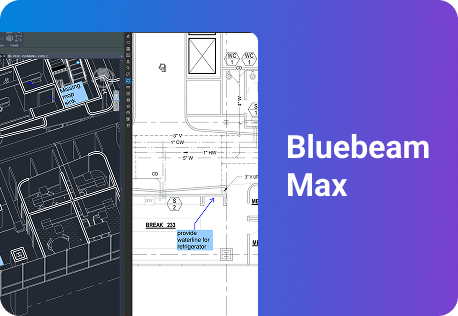
He was inspecting the new east grandstand at Oregon State University, a sprawling, multiyear project, when he walked into the contractor’s job trailer to go over the plans. On the wall was a 60-inch monitor, and on the monitor was Bluebeam — plan sets, RFIs and field communication, all live and moving. Carlson had never seen anything like it. “Wow, what is that?” he remembers saying. “That looks super cool.”
What he saw was a way out of a problem he had been wrestling with for years. As Corvallis’ building official, Carlson had been hunting for an electronic plan review tool and coming up empty. The systems built for that purpose were priced for big institutions — by his recollection, the leading option ran around a quarter-million dollars. Bluebeam cost a few hundred dollars a license. He started experimenting, bought licenses for his review staff and found that the software did the job those expensive systems were built for at a fraction of the price. It worked, and it changed how his department operated.
When he began teaching in 2016, Carlson started picturing Bluebeam in the curriculum. For a while the classroom still ran on paper, with students laying sheets of plexiglass over printed plan sets and marking them up by hand, doing calculations the way generations of inspectors had. Then the pandemic forced the issue. The classroom went remote, the paper workflow collapsed and the question answered itself.
“COVID really pushed us to go, ‘OK, we had to get real about doing electronic plan review in the classroom,’” Carlson says. “And Bluebeam was the answer.”
The shift was not only about teaching. Electronic plan review is now the working reality of the profession in Oregon. A 2021 update to state law, effective January 2025, requires every jurisdiction to have a permitting system capable of electronic plan review — making the skill something graduates are expected to bring on day one.
Why Chemeketa teaches Bluebeam from the first term
Carlson made a deliberate choice about when students meet the software. Rather than save it for later in the program, the way he had seen it taught elsewhere, he put Bluebeam in the very first term. He had heard the regret from students who came to it late: they had spent months marking up drawings in general-purpose PDF tools when they could have been building fluency in the software the field runs on.
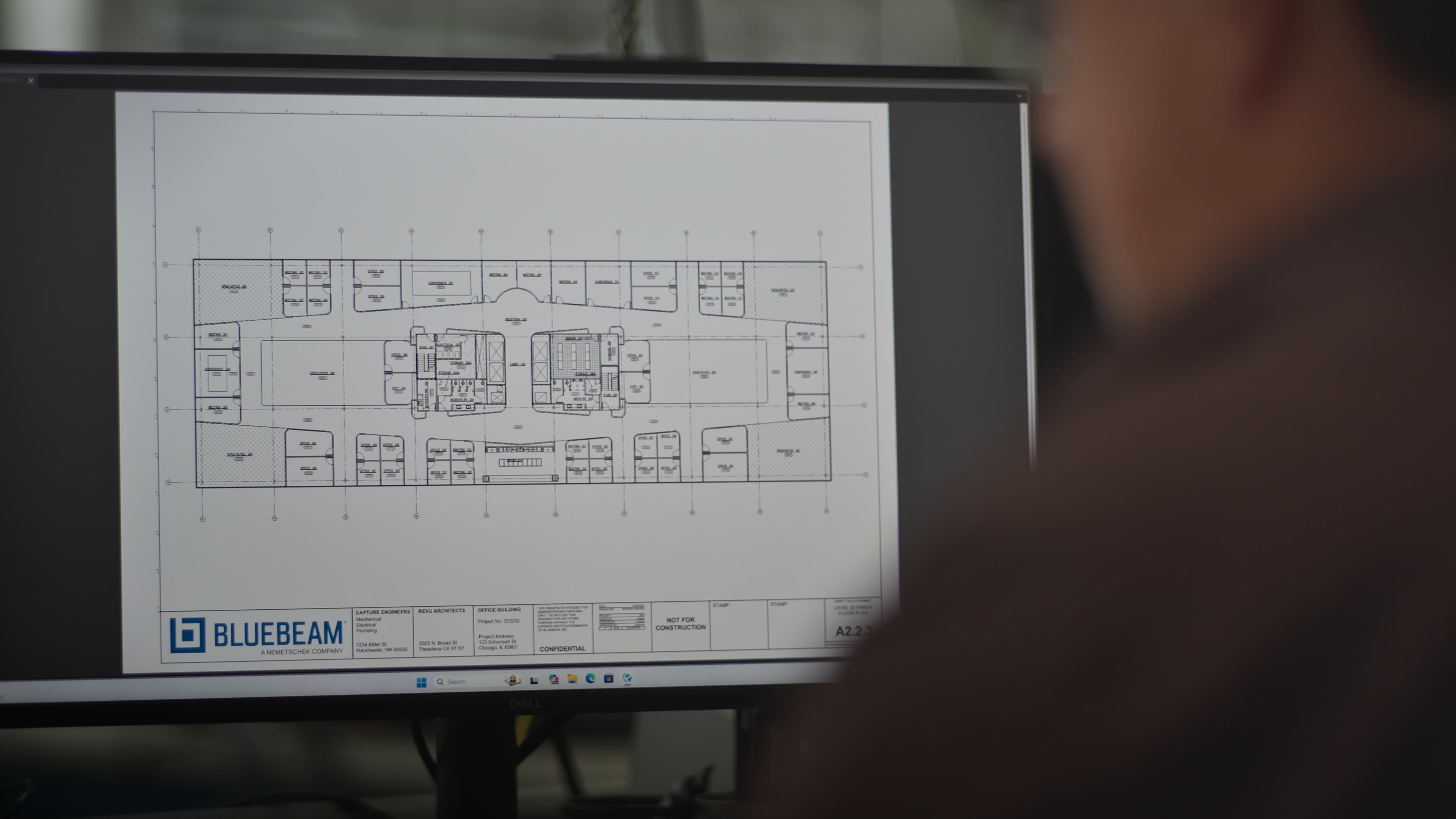
So at Chemeketa, Bluebeam comes first. Essentials of Bluebeam is a one-credit class students take in their opening term, and from there they never put the tool down. Every plan review, every assignment and every collaboration with their classmates runs through it for the next two years. The logic is simple: fluency compounds.
The graduates make the case better than anyone. Heaven Doherty, who came up through 13 years in local government and now inspects and reviews plans for the city of Hermiston in Eastern Oregon, says learning the tool early shaped everything that followed: “You’re already in a plan-review class, learning the symbols and how to read a set of drawings. Having all of that on Bluebeam from the start, and using it the whole way through, makes a real difference.”
Heidi Kameroff, a journeyman roofer who now inspects and reviews plans for Lincoln County on the Oregon coast, extends the point past plan review into everything else the software touches: “You can use it for everything — not just plan review, but viewing documents and running Studio Sessions back and forth on assignments with your cohort.”
What the program is really teaching, underneath the software, is a skill: how to read a set of drawings, mark it up and communicate those comments clearly enough that a contractor in the field knows exactly what has to change. And the time savings are real. Carlson estimates electronic plan review runs 30% to 60% more efficient than the old paper method, with the biggest gains on large projects where several disciplines can review at once.
The clearest proof came at the NW Natural Street of Dreams, a summer showcase of new homes that landed in Wilsonville in 2019 with six houses on the program. Carlson used the moment to flip the plan review process on its head. Instead of builders dropping off plans and waiting weeks for the city to call when the review was done, he had them schedule their reviews in advance. “Builders have a schedule. They know when they’ll submit plans to the city and how long it should take,” he says. “Why not earmark that date, block it out on the reviewers’ calendars and make the review happen in a day? We built the city into the builder’s schedule.”
Once the calendars were aligned, Bluebeam Studio did the rest, letting reviewers from multiple disciplines mark up the same plan set at the same time. Carlson’s team cleared all six homes in a single day. “Applicants either had a permit in hand the next day or knew exactly what they needed to revise to comply with the code, so they could start working,” he says. “It’s the type of streamlined permit process I wish we could do with every project.”
To teach the tool, Carlson became a Bluebeam Certified Instructor, and the program runs on licenses provided through the Bluebeam Academic Program.
Inside Oregon’s building inspector shortage
The math makes Chemeketa’s work urgent. A 2014 national survey by the International Code Council and the National Institute of Building Sciences found that 82% of the country’s code professionals expected to retire within 15 years, 30% of them within five. That wave is breaking now. Carlson calls it the silver tsunami.
In Oregon, the Employment Department projects about 200 job openings a year for construction and building inspectors against a workforce of roughly 1,800 — a replacement rate the state’s training pipeline cannot meet. Chemeketa is one of Oregon’s few dedicated sources of new code professionals, and even it graduates only 8 to 15 a year. The shortfall lands on understaffed building departments at exactly the moment Oregon is trying to build its way out of a housing shortage. Every home the state needs is also a home someone has to inspect and approve.
Demand is so steep that interest in the program has surged. Enrollment is capped at 30 students a year, and last year 52 people applied, more than the program could take. The pull is partly generational: Oregon’s aging construction workforce includes many tradespeople looking for a way to put decades of building knowledge to use without the physical toll of the job site. Since the program restarted in 2016 it has graduated 8 to 15 students a year, and because it runs entirely online, those graduates have come from across Oregon, Washington, Idaho, Montana, California and once from Minnesota. The ICC certifications they earn are recognized nationwide, so they can take the credential wherever the work is. All told, the college says the program has produced more than 800 graduates since 1978.
The people closing that gap are not who you might picture. They are, very often, the people the trades thought they had lost.
Kameroff spent about 20 years in the trades and is a journeyman roofer, but an injury ended her time on the roof. “I didn’t want to leave an industry that I had worked so hard to become a journeyman in,” she says. “But physically, there was no way for me to continue to do what I did. And you can’t really be a remote roofer.” She went through vocational rehabilitation, but nothing jumped out — everything they wanted to put her in was an office job. After other options fell through, she looked online, found the Building Inspection Technology program and enrolled. She had never touched Bluebeam. Today she does inspections and plan reviews for Lincoln County, a job she cares about enough to drive up to 90 minutes each way to do.
What the program gave back was harder to measure than a paycheck. “When you find something that you’re passionate about, and then all of a sudden that’s gone, what do you do with that?” she says. “By the time I got to the end of the program, I was suddenly passionate about something again. And I hadn’t felt that way since before I got hurt.”
Doherty came to it differently — more than a decade in a local government finance department and years working for a general contractor before she moved into a building department, then into inspection. She, too, came in without any Bluebeam experience. Now both women open the software every day.
What made the path possible for both of them is the shape of the program itself. Nearly all of Chemeketa’s classes run live at night over Zoom, three or four evenings a week, so students do not have to quit their jobs to attend. It is a direct inversion of Carlson’s own experience as a student in the 1990s, when the program was daytime and enrolling meant walking away from a paycheck. The rigor is real — two years of dense, technical code work after a full day of your own — and not everyone makes it through. But for the people it fits, it is a second career that does not require dismantling the first.
What building inspectors do for their communities
Ask the graduates what the job means, and the answer is never about software. It is about the people on the other side of the plan set.
“It’s always a privilege to serve your community and to make things safer and better for people,” Doherty says. “It’s such an important role, and I don’t think people think about how much time they spend in buildings, and whether those buildings are safe.” Carlson frames the stakes in numbers: by the Environmental Protection Agency’s estimate, Americans spend about 90% of their time indoors. The people who make sure those spaces are safe, accessible and sound mostly do it without anyone noticing.
“I didn’t have to do a whole lot of extensive training for plan reviews with my hire — she [Heidi Kameroff] was very capable from the start.”
John Rodriguez
Building Official
Lincoln County
The job also takes more than technical skill, which is why the program puts real weight on communication. Students work from an International Code Council text on inspector soft skills, practice leading meetings and giving presentations — sometimes recording themselves for coaching — and have their written correction notices graded on tone and clarity as well as accuracy. They are taught to cite the specific code section behind every correction, as Oregon law requires, and to explain the intent behind it rather than simply issue a ruling. Even the willingness to say “I don’t know, and I’ll get back to you” is taught as a discipline, paired with the obligation to follow through, because on a job site time is money and projects must keep moving.
For Kameroff, the weight of it became real on the Oregon coast in 2020, when wildfire tore through the Otis area near Lincoln City — something almost no one saw coming. “Nobody ever thought that the coast would catch on fire,” she says. Much of what she inspects now is the rebuild: standing in the wreckage alongside homeowners who lost everything, helping them put their lives back together to today’s codes.
She met one homeowner whose house was among the first to burn, a man who was asleep when the fire came and survived only because a neighbor pulled him out. He rebuilt with severe PTSD, and through the whole process he kept asking the same question: How do we make this house as safe as it possibly can be? Answering that question, repeatedly, is the part of the job that does not shut off at 5 o’clock.
“We’re advocates, not just inspectors,” Kameroff says. “We’re advocates for safer buildings, safer structures.”
Why employers hire Chemeketa graduates
Chemeketa has offered the building inspection degree since 1978, and the modern version, rebuilt by Carlson and his colleagues in 2016, has drawn national recognition, including the International Code Council’s Raising the Profile Award, which Carlson received in 2023.
The 2016 revival was less a single decision than a case that built up over time. Glen Miller, then director of Chemeketa Community College’s Polk Center, had watched it shape careers — including Carlson’s — and made the call to bring it back. “I had worked with the building inspection program for several years as the internship coordinator at Chemeketa,” Miller says. “I had seen firsthand the value of the program to both the students and the industry. I have also known Dan Carlson since the early ’90s and saw the impact it had on his career and family. In 2015, as the construction industry was rebounding from the 2008 downturn, Dan presented me with information about the need for well-trained building inspectors to meet the demand. He also put me in contact with a number of other building officials that echoed the same concerns. The relatively low cost of starting the program, combined with the industry need and family-wage jobs, made it a worthwhile program to restart.”
An informal survey of city and county jurisdictions confirmed a major shortfall and a wave of coming retirements, the same silver tsunami the national ICC data warned about. The program’s bones — administration, curriculum — were still in place, and because building inspection requires instructors more than expensive equipment, it was relatively inexpensive to run. The case made itself.
Building officials who hire the program’s graduates describe the same advantage from the other side of the desk. John Rodriguez, the building official for Lincoln County, says the Chemeketa training shows up immediately. “I didn’t have to do a whole lot of extensive training for plan reviews with my hire — she was very capable from the start,” he says of Kameroff. A big part of that is the Bluebeam fluency: graduates arrive having learned the software the right way, through the program and Bluebeam University. “Someone who isn’t from this college wouldn’t have received such a wealth of knowledge.”
That readiness matters in a hiring market Rodriguez describes as painfully thin. Qualified inspectors, he says, are either content where they are or have left the field for better-paying work in the trades, which leaves building departments with few good options. “Having a wonderful program like the one at Chemeketa is very beneficial for building departments all around Oregon,” he says. “You know you’re hiring a capable and well-versed person for your staff in codes and plan review.”
What employers get out of it is the thing Carlson is proudest of. When a building department hires a Chemeketa graduate, he says, they are not starting from zero: “They’re getting someone who’s been exceptionally well prepared to leap right into the deep end. They’re not having to learn Bluebeam on the job. They’re not having to learn the codes on the job at the same time they’re learning to be an inspector.”
The graduates feel the difference from the inside. “I am such a better inspector because of going through the program,” Kameroff says. Doherty describes a workload that would have been unimaginable before: multi-certified in commercial and residential plumbing and mechanical, she now handles 30 to 70 inspections a day on everything from three-story apartment buildings to data centers. “I wouldn’t be able to do that without Chemeketa,” she says. Both push back on the idea that the credential is just a box to check — this is a career they intend to keep, not a job they happened to land.
A model built to scale
The model is also poised to grow. In 2025, the Oregon Legislature passed Senate Bill 1086, directing the state to help the Oregon Building Officials Association develop a proposal for a building inspector apprenticeship program — part of a broader push to address the housing and code-workforce shortage, in alignment with the state Building Codes Division and the Bureau of Labor and Industries. The building officials association has identified Chemeketa as its intended education provider for the apprenticeship, which is targeted to launch in 2027.
“Bluebeam didn’t become essential in my life until I became a code professional. Now I open it every single day.”
Heidi Kameroff
Building Inspector and Plans Examiner
Lincoln County
Today, the program already reaches beyond the classroom. It funds scholarships — including $600 grants that help new students buy code books and the dual-monitor setups they need to learn electronic plan review — and runs one of only a handful of student ICC chapters, where students build the leadership and networking habits the job demands.
The shortage Chemeketa is working against is national, and the model — train the people the trades left behind, give them the codes and the tools together and send them into the field ready to work — is one that scales. In Oregon, it comes down to something simple: The state cannot build the homes it needs without the people who inspect them. Chemeketa, with Bluebeam built into the work from the first week of class, is making sure those people exist.