


ZGF Architects
PDX Reimagined: How a Digital Backbone Powered America’s Most Ambitious Airport Project
A new way to supercharge Revu with AI.

The Complete Guide to Construction Takeoffs in 2026


The Complete Guide to Construction Estimation in 2026What it is, how it works, why it matters and how to get better at it.

There’s a moment every estimator knows. You’re three hours into a set of drawings, measuring conduit runs or counting devices, and something doesn’t line up. The structural sections contradict the architectural plans. The finish schedule references a spec section that doesn’t exist. The site plan shows a retention pond, but the civil drawings have no grading for it.
That moment is where projects get saved or start bleeding money.
Construction estimation is the process of figuring out what a project will cost before anyone builds it. It’s arguably the most consequential financial exercise in the project lifecycle, and it happens before a shovel touches dirt, before a contract is signed, before a single crew member even knows the job exists.
Get it right and the project has a real shot. Get it wrong, even by a few percent, and the math works against you from day one.
This guide covers all of it: what estimation is, how the process works, what separates a solid estimate from a dangerous one, how technology is changing the craft and how to build a workflow that holds up under real-world pressure. Whether you’re an estimator looking to sharpen your process, a PM who needs to understand where the numbers come from or a firm owner watching margins erode, this is the foundation.
What is construction estimation?

Construction estimation is the process of calculating the anticipated cost of a construction project based on its design documents, specifications, site conditions and current market factors. It produces the number a contractor stands behind when submitting a bid or negotiating a contract.
That number is not a guess. It’s the output of a structured process that starts with drawings and ends with a financial commitment. In between, someone has to measure every quantity the drawings call for, apply current costs for materials and labor, account for equipment, factor in overhead and profit, and build in enough contingency to absorb the things that go sideways. All without padding so much that the bid stops being competitive.
The people who do this work are estimators. They occupy one of the most important and least understood roles in construction. An estimator is not an accountant looking backward at what got spent. An estimator is a forecaster looking forward at what will need to be spent, based on design intent, construction knowledge and a hard-earned sense of what projects ultimately cost to build.
Who estimates and why it matters
General contractors, specialty subcontractors, civil contractors, design-build firms, owners’ reps and independent estimating consultants. Anyone who puts a price on work before the work begins.
Why does it matter? Margins. The average net profit margin for general contractors sits at about 5% to 6%, according to multiple industry benchmarks. Top performers reach 10% to 12%. On a $10 million project, that means the contractor clears roughly $500,000 to $600,000 after everything gets paid. One missed scope item, one flawed labor assumption, and that margin is gone.
Estimation vs. estimating software
These get conflated constantly. Construction estimation is the discipline: the knowledge, judgment and process that produces a reliable project cost. Construction estimating software is one of the tools that supports the discipline.
Software makes estimators faster and more accurate. But it does not replace the thinking. An experienced estimator with a spreadsheet will outperform a novice with a $50,000 platform every time.
This guide focuses on the discipline. For a deep dive into the software side (platform types, features and how to choose), see Construction Estimating Software: The Complete Guide.
The estimation process, step by step
Every estimator develops their own rhythm, but the underlying process is remarkably consistent across firms, trades and project types. What changes is the emphasis, the tools and how much runs on automation vs. manual effort.
Step 1: Review the bid documents
Before measuring anything, the estimator reads. Drawings, specifications, geotechnical reports, addenda, general conditions, owner requirements. The full package.
This is not skimming. It’s a deliberate effort to understand what the project is, what’s included, what’s excluded and where the risk sits. Experienced estimators read for what isn’t there as much as what is: missing structural details, finish schedules that contradict the reflected ceiling plan, spec sections that reference unfamiliar standards. The review phase builds the mental model of the project, and the quality of that model determines everything that follows.
Step 2: Perform the quantity takeoff
The takeoff is the foundation. It’s the process of measuring and documenting every quantity the drawings show that needs to be built: lengths of wall, areas of flooring, volumes of concrete, counts of fixtures, linear footage of conduit.
Takeoffs answer one question: what does this project require, in measurable terms? No costs yet. Just the geometric truth of what the drawings call for.
This step matters enough that we built an entire guide around it. For the full breakdown of quantity takeoffs, material takeoffs, digital workflows and revision management, see Construction Takeoffs: The Complete Guide to Quantity & Material Takeoffs in 2026.
The short version: if the takeoff is wrong, the estimate is wrong. No amount of pricing work downstream can fix bad quantities. For a closer look at why this matters more than most teams realize, see Your Takeoff Is Wrong. Here’s Why That Matters More Than You Think.
Step 3: Apply costs
Once quantities are established, pricing enters the picture. Material costs come from supplier quotes, internal cost databases or published sources like RSMeans. Labor costs are calculated by multiplying estimated hours per unit of work by the applicable labor rate (which varies by trade, region and union status). Equipment costs cover everything from crane rentals to small tools.
The best estimating teams maintain their own cost databases populated with actual costs from completed projects. A database built over years and updated constantly is one of the most valuable assets a contractor owns. It turns institutional knowledge into data.
Step 4: Build assemblies and apply waste factors
An assembly is the estimating equivalent of a template. A concrete slab assembly might include concrete, rebar, vapor barrier, formwork, finishing labor and curing compound, all triggered by a single area measurement. For a practical look at how assemblies work inside a takeoff tool, see how estimates for assemblies are built in Bluebeam Revu.
Waste factors adjust net quantities to reflect procurement reality. A slab measuring 185 cubic yards on the drawing might require 195 ordered because pumps need priming, forms are not perfectly level and the leftover stays in the truck.
This is where estimating experience shows. A veteran knows that 5% waste on drywall in a hotel with 200 identical rooms is tight but defensible. The same 5% on a museum with curved walls and custom reveals is a problem waiting to happen. That judgment comes from years of comparing what the estimate predicted to what the field consumed.
Step 5: Level subcontractor bids
For scopes not self-performed, the estimator solicits and evaluates subcontractor quotes. Bid leveling means comparing sub bids side by side to find scope gaps, duplications, exclusions and outliers.
When three electrical subs bid the same job and one comes in 30% below the other two, that’s not a bargain. That’s a scope problem. The low number is usually missing something, and the estimator’s job is to figure out what before it becomes a field problem.
Step 6: Add indirect costs
Direct costs (materials, labor, equipment, subs) are the visible layer. Indirect costs are the invisible one and often where margin gets made or lost.
General conditions cover site supervision, temporary facilities, cleanup and safety. Then there’s insurance, bonding, taxes, overhead allocation and profit. None of these show up on a drawing, but they are as real as the steel and concrete. A project perfectly estimated on direct costs but underestimated on general conditions will still lose money.
Step 7: Validate against benchmarks
Before the bid goes out, the best estimators pressure-test the number. They compare cost per square foot against similar completed projects. They check unit rates against historical data. They look at the total and ask whether the number holds up given the project type, location and market conditions.
This benchmarking step catches errors that are invisible at the line-item level but obvious at the macro level.
Step 8: Generate the proposal
The estimate becomes a bid. The bid includes the price, exclusions, qualifications, schedule assumptions and any alternates. That document is the firm’s financial commitment. Everything upstream was in service of getting that number right.
Why estimation accuracy matters
The industry treats accuracy like a best practice. It’s not. It’s survival.
Average net profit margins for general contractors run about 5% to 6%. Every dollar of estimating error comes directly out of that. A 3% miss on a $20 million project is $600,000, potentially more than the entire net profit on the job.
According to CFMA’s 2025 Financial Benchmarker, net income before taxes averaged 6.7% of revenue across the industry, up from 6.3% the year prior, with best-in-class firms reaching roughly 12%. The gap between average and top performers is largely a function of estimating discipline.
The Winner's Curse
You win a job, but for the wrong reason. You won because scope was missed, a quantity was underestimated or a site condition was not accounted for. The bid came in low not because the team is more efficient, but because the estimate was incomplete.
Recovering from that position means change orders (which damage the owner relationship), value engineering under pressure (which compromises quality) or absorbing the cost. All of those outcomes trace back to the estimate.
Overestimation is not harmless
Padding quantities to compensate for uncertainty feels safe. It’s not. It makes bids less competitive. Over time, firms that pad consistently lose work to competitors who are more precise.
Accurate takeoffs let estimators bid confidently, without hiding behind contingency. The estimate should reflect the project, not the estimator’s uncertainty.
Types of construction estimates
Not every estimate requires the same level of detail. The right type depends on where the project sits in the design lifecycle and what decision the estimate needs to support.
AACE International’s Recommended Practice 56R-08 (free for AACE members, available for purchase by non-members) provides the standard classification system for building and general construction. It maps five estimate classes to the maturity of project definition, from Class 5 (least defined) through Class 1 (most defined). The core principle is straightforward: as scope definition improves, accuracy tightens.

At the early end, a Class 5 order-of-magnitude estimate is produced with almost no design information. It’s a screening tool for feasibility, not a budget. Accuracy can swing from -30% on the low side to +50% on the high side, and for complex or poorly defined projects, the variance can be even wider. At the other end, a Class 1 definitive estimate is built from complete construction documents with accuracy typically ranging from -5% to +10%. That’s the bid estimate, the one with the contractor’s name on it.
The classification matters because mismatched expectations about estimate type are a common source of project conflict. When an owner treats a Class 4 conceptual number as a Class 1 bid, the project is headed for a budget conversation nobody wants. AACE emphasizes that accuracy ranges are not preset values you can apply automatically. They must be determined through project-specific risk analysis, considering scope maturity, estimator experience, data quality and site complexity.
The estimation landscape in 2026

Three forces are reshaping construction estimation right now.
Labor scarcity
The construction industry needs to attract roughly 349,000 net new workers in 2026, according to Associated Builders and Contractors. That number climbs to 456,000 in 2027. More than half of the 2026 demand is driven by retirements, not new project growth. About one in five construction workers is over 55, and the
AGC/NCCER 2025 Workforce Survey found that 92% of firms with open craft positions reported difficulty filling them. For estimators, this means labor productivity assumptions based on historical norms may no longer hold. Crews are thinner, experienced workers are harder to find and overtime is more common. Immigration enforcement is compounding the problem: the AGC’s 2026 Construction Hiring and Business Outlook found that about a third of firms have been directly or indirectly affected by enforcement actions, further tightening labor supply in regions that were already short-staffed. All of that affects labor hours per unit of work.
Material price volatility
Steel and aluminum tariffs have escalated sharply. Section 232 duties hit 25% in March 2025, doubled to 50% in June 2025 and now operate under a tiered structure as of April 2026: 50% on articles made entirely or mostly of steel, aluminum or copper; 25% on derivative articles substantially composed of those metals; and lower rates for certain grid equipment and domestically smelted materials. Concrete costs have climbed roughly 7% to 9% year over year, according to industry pricing data from sources including Gordian. Electrical components have seen substantial producer price index increases since 2003, with sharp acceleration since 2021 driven by grid demand and transformer shortages.
For estimators on fixed-price contracts, every material price increase between bid day and installation day comes directly out of margin. The firms that protect themselves use the most current pricing data and update cost databases frequently.
Technology acceleration
Cloud-based estimating platforms now represent most of the market revenue. Mordor Intelligence estimates the global construction estimating software market at about $3.07 billion in 2026, growing at a compound annual rate of roughly 12.7%, with cloud deployment continuing to gain share over desktop installations. AI-assisted takeoff tools can reduce counting tasks from hours to minutes.
What makes a good estimator
Software gets plenty of attention. The person behind it does not get enough.
A good estimator reads a set of drawings and understands how the building goes together. They anticipate problems the field will face before the field faces them. They look at a number and know whether it’s right, not from checking the math, but from judgment built over years of projects.
Construction knowledge
Knowing a concrete mix design costs a certain amount per yard is not enough. You need to know the site has limited access, the nearest batch plant is 45 minutes away, the engineer wants continuous placement and that all those factors change the cost.
Takeoff discipline
The best estimators calibrate scales, organize quantities by system and floor, verify scope against specs (not just drawings) and make their work reviewable. Not because they distrust their own numbers, but because fresh eyes catch what familiarity misses. For more on building this discipline, see the Complete Guide to Construction Takeoffs.
Market awareness
Material prices shift. Labor markets tighten. Supply chains break. A good estimator tracks all of it through phone calls, trade relationships and paying attention, not just through a database.
Judgment
The hardest quality to teach. An experienced estimator sees things that don’t add up: the architect specified curtain wall, but the structural drawings show bearing walls, the MEP drawings contradict the ceiling heights, the site plan shows a feature the civil drawings never address. Each of those observations, caught at the estimating stage, prevents a problem that would have cost real money in the field.
How technology is changing estimation
Digital takeoffs
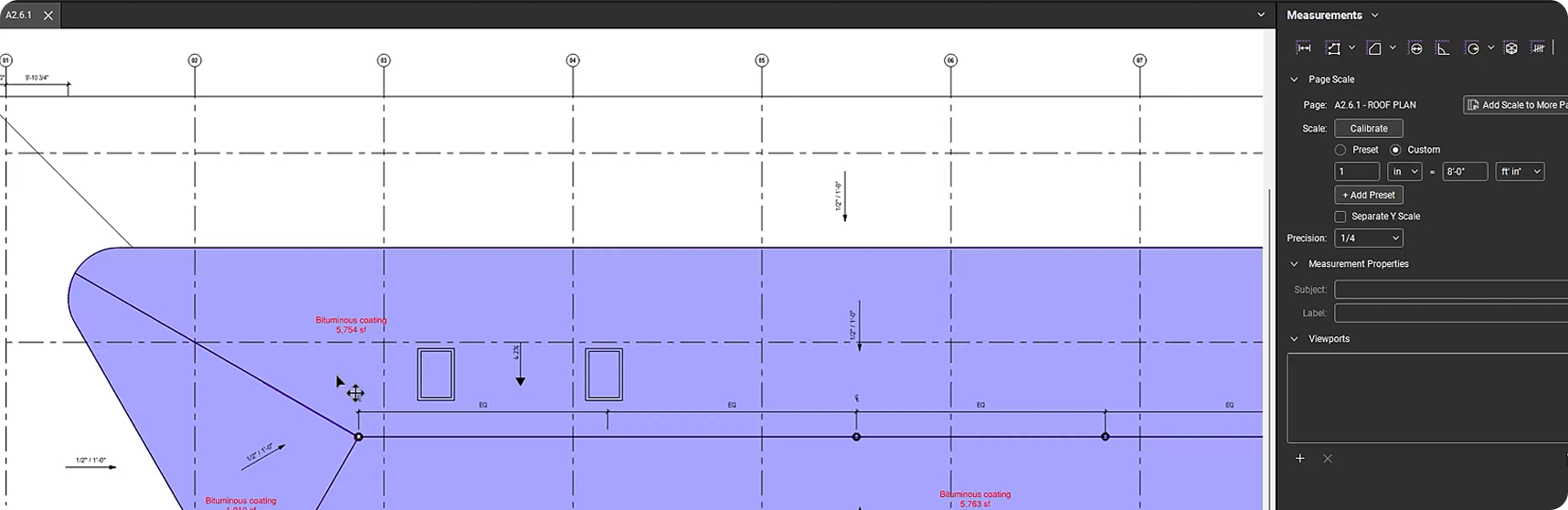
PDF-based takeoff tools replaced scale rulers and colored pencils. On-screen measurements serve as both a visual markup and a structured data record, meaning you can see what’s been counted, how it was measured and where it sits in the scope.
Bluebeam’s takeoff tools were built around this idea. Every measurement ties to both a drawing markup and a quantity record, making takeoffs auditable by design. Features like Quantity Link connect measurements directly to Excel spreadsheets so totals update in real time as the takeoff progresses. Custom tool sets let teams standardize how quantities are captured across multiple estimators, and VisualSearch automates symbol counts that used to take hours. For a deeper look at how these tools work together in practice, see how Revu’s measurement tools support quantity takeoffs.
AI-assisted quantity capture
AI-driven symbol detection can scan a drawing set and identify every instance of a fixture, device or component in seconds. Tasks that took hours now take minutes.
The shift is not just speed. It changes the estimator’s role from manual measurement to validation. The estimator defines what to look for, reviews results and confirms what gets counted. Bluebeam’s VisualSearch is built on this model.
Cloud collaboration
Estimating used to be solo work. Cloud platforms turned it into a team effort. Multiple estimators work on different trades in a shared environment, with changes reflected in real time. No more merging spreadsheets from six people, which is how data gets lost and bids get blown.
Integration
When estimating data flows into accounting, project management and field systems without manual re-entry, errors drop and the firm builds a feedback loop between what was estimated and what was spent. That loop is how estimating improves over time.
Common estimation mistakes
Treating software as a calculator
Firms that never build out their cost databases end up entering prices manually on every bid. The software becomes an expensive spreadsheet.
The spreadsheet reversion
If the platform is too rigid, experienced estimators go back to Excel. It happens constantly. Good software provides structure without removing the flexibility veterans need.
Skipping the takeoff review
A quantity that lives only in a table is a quantity nobody can verify visually. Quantities tied to markups on the drawing can be reviewed by eye, which is how you catch missed rooms, duplicates and bad assumptions. When Solid Earth Civil Constructors switched from paper to digital estimation in Bluebeam, a side-by-side comparison of their first digital bid against the paper version uncovered a mistake that would have cost the company more than $50,000.
Ignoring the field-office gap
When the field team can’t use the estimating platform for change orders, a silo forms. The estimate built in the office disconnects from what’s happening on-site. The firms that close this gap are the ones that learn from their estimates. For a practical look at how structure prevents this breakdown, see why most takeoffs fall apart when drawings change.
Estimating in a vacuum
An estimate built without a site visit, without sub pricing, without checking current market conditions is an estimate built on assumptions. Some will be wrong.
How to learn construction estimating
Formal education
Construction management, civil engineering and architecture programs all cover estimating fundamentals. The American Society of Professional Estimators (ASPE) offers the Certified Professional Estimator credential. AACE International offers the Certified Cost Professional for heavier construction and owner-side work.
On-the-job learning
Most estimators will tell you the real education happened on the job: working alongside experienced estimators, reviewing completed projects against original estimates, doing enough takeoffs that the process becomes second nature.
Self-directed resources
RSMeans provides reference pricing data. Bluebeam University offers courses on digital takeoff workflows. Trade-specific organizations (NECA for electrical, MCAA for mechanical) publish estimating standards. For practical tips on using digital tools for quantity takeoffs, this overview of QTO workflows in Bluebeam Revu is a good starting point.
Start with takeoffs
If you’re new, start with quantity takeoffs. Learn to read drawings, measure accurately and organize quantities so someone else can review them. Pricing and bidding skills build on that foundation.
Estimation by project type
Residential
Speed and client-facing proposal quality matter most. Projects are smaller, but revision cycles are fast and homeowners expect polished quotes quickly.

Commercial
Detailed work breakdown structures, CSI MasterFormat compliance and the capacity to manage high volumes of sub bids. Multi-user collaboration and bid leveling are requirements. The estimate often becomes the initial job budget.
Heavy civil and infrastructure
Unit price contracting dominates. Massive quantities, productivity rates for heavy equipment and mobilization costs that can make or break the bid.
Specialty trades
Electrical subs estimate around NECA labor units. Mechanical contractors use MCAA WebLEM. Concrete contractors work with trade-specific assemblies tuned to their materials and installation methods. Many specialty firms run a two-system approach: a takeoff tool like Bluebeam for quantity capture and a trade-specific cost platform for pricing. Cummings Electrical went fully digital with its estimating workflow using this approach, eliminating paper entirely and standardizing processes across the firm.
Estimation and the rest of preconstruction
The estimate-to-budget handoff
When the project is awarded, the estimate should become the initial job budget. If that handoff requires manual re-entry, errors creep in and data gets lost.
Post-project feedback
The most important thing most firms don’t do. Comparing actual costs against the original estimate, line by line, is how estimators learn where assumptions are consistently off.
The firms that build a feedback loop between the estimate and the field get more accurate over time. Everyone else keeps guessing at the same rate.
The role of AI in construction estimating
AI is here and it’s useful. Current applications focus on the most time-consuming parts of the process: reading drawings and counting things.
AI-driven symbol detection scans drawing sets and identifies every fire alarm, light fixture or plumbing fixture in seconds. In specialized trades, AI-assisted tools have reduced takeoff time dramatically while maintaining or exceeding manual accuracy. The market is moving fast: Procore acquired AI-data-integration firm Datagrid in January 2026, Autodesk has reported significant takeoff speed gains through its Forma Takeoff platform and purpose-built tools like Togal.AI and Kreo are gaining traction with GCs and subs. Industry surveys suggest AI workflow adoption in estimating has roughly doubled since 2023.
But AI cannot account for difficult site access, an architect whose drawings routinely miss structural details or local market conditions that make standard labor rates unrealistic. That judgment, built from years of project experience, is what turns a quantity list into a winning bid.
The consensus among experienced estimators: AI is a powerful assistant, not an authority. The estimator drives. The tools make them faster.
Frequently asked questions
What is estimating in construction?
The process of calculating the total anticipated cost of a project before construction begins. It covers quantity takeoffs, material and labor pricing, equipment costs, subcontractor coordination, indirect costs, overhead and profit.
Why is estimation important in construction?
Most contractors operate on net margins of 5% to 6%. A missed system, a flawed assumption or incomplete scope can erase the entire profit on a job.
What is a takeoff in construction estimating?
A takeoff measures and documents quantities from construction drawings (lengths, areas, volumes, counts) before pricing is applied. See Construction Takeoffs: The Complete Guide for the full treatment.
What is cost estimation in construction?
The stage where measured quantities meet financial data: material prices, labor rates, equipment costs, sub quotes and indirect costs.
What is ROM in construction estimating?
Rough order of magnitude. An early-stage estimate produced with minimal project definition, typically at the conceptual or feasibility stage. AACE’s 56R-08 classification shows typical accuracy bands of -20% to -30% on the low side and +30% to +50% on the high side for Class 5 estimates, though weak project systems can push the high end even further. Treating a ROM as a budget is one of the most expensive mistakes in project planning.
How do I choose construction estimating software?
Start with your workflow. Identify whether your process is takeoff-first or cost-database-first. Match the platform to your project type, team size and integration needs. See Construction Estimating Software: The Complete Guide.
How to use AI in construction estimating
AI works best in the quantity capture phase: scanning for symbols, identifying patterns, automating counts. The estimator defines what to look for and validates results. Bluebeam’s VisualSearch is built on this model. Here’s how to get started with Bluebeam as an estimator.
Can I use Excel for construction estimating?
For simple projects, yes. For anything with multiple trades, frequent revisions or team-based estimating, Excel lacks the database structure for standardization, version control for multi-user work and traceability for post-project analysis.
How to start a construction estimating business
Build your reputation as an estimator first. You need deep trade experience, a reliable cost database, professional liability insurance and a network of contractors who trust your numbers.
How do construction methods affect estimating?
Every method carries different cost implications. Stick-built means high field labor. Prefabrication shifts costs toward manufacturing. Tilt-up, steel frame, wood frame: each drives different quantities, productivity rates and equipment requirements.
What do construction estimating tools do?
Estimating tools digitize the process of measuring quantities from drawings, applying costs, managing sub bids and generating proposals. At the takeoff layer, tools like Bluebeam let estimators measure directly from PDFs with results tied to both a visual markup and a data record. At the pricing layer, dedicated estimating platforms manage cost databases, assemblies and bid leveling. For a full comparison of tool types, see Construction Estimating Software: The Complete Guide.
What is the best construction estimating software?
It depends on your workflow, project type and team size. A five-person electrical sub and a 500-person commercial GC have fundamentally different needs. The right answer starts with understanding whether your process is takeoff-first or cost-database-first and what integrations you need downstream. For a detailed comparison by use case (commercial, residential, subcontractors, cloud-based, concrete and masonry), see Construction Estimating Software: The Complete Guide.
What is auto estimating in construction?
Auto estimating refers to the use of AI and automation to handle repetitive parts of the estimating process, primarily symbol counting, pattern recognition and quantity capture from drawings. It does not mean fully automated estimates. The estimator still defines scope, validates results and applies judgment. Bluebeam’s VisualSearch is an example: it scans drawings for visual patterns and returns counts that the estimator reviews and confirms.
How to use ChatGPT for construction estimating
Large language models like ChatGPT can help with estimating-adjacent tasks: drafting scope narratives, writing bid qualifications and exclusions, summarizing specifications, comparing material options and generating rough cost ranges for early feasibility discussions. They are not reliable for producing actual bid numbers, because they lack access to current pricing data, local labor rates and project-specific conditions. The real value is in reducing the administrative load around estimating, not in replacing the estimating itself.
Where can I find construction estimating courses?
ASPE offers the Certified Professional Estimator (CPE) program and chapter-based training. AACE International provides the Certified Cost Professional (CCP) track. Bluebeam University offers courses on digital takeoff workflows specifically. Trade associations like NECA and MCAA publish estimating resources aligned to their standards. Many community colleges and universities offer construction estimating courses within construction management or civil engineering programs.
The bottom line
Construction estimation looks straightforward from the outside. Measure things. Put prices on them.
One layer down, it’s risk management, applied judgment and a financial commitment the firm lives or dies by. The tools keep getting better. Digital takeoffs replaced scale rulers. Cloud platforms replaced merged spreadsheets. AI is replacing manual counting. Each improvement makes the process faster and more accurate. None of them replaces the estimator.
The person who reads the drawings, understands how buildings go together and knows the difference between a number that looks right and one that is right, that person is still the most important variable.
The firms that invest in their estimating capability, people and process and tools together, consistently win work at margins they can deliver. The firms that treat estimating as an afterthought keep wondering why projects come in over budget.
Ready to see how Bluebeam supports accurate, collaborative takeoff and estimating workflows? Start a free 14-day trial or explore Bluebeam’s takeoff and estimation capabilities.
Table of Contents
- What is construction estimation?
- The estimation process, step by step
- Why estimation accuracy matters
- Types of construction estimates
- The estimation landscape in 2026
- What makes a good estimator
- How technology is changing estimation
- Common estimation mistakes
- How to learn construction estimating
- Estimation by project type
- Estimation and the rest of preconstruction
- The role of AI in construction estimating
- Frequently asked questions
- The bottom line

