





IHI Energy Solutions Inc. isn’t trying to be the biggest EPC firm on the planet. But it is absolutely trying to be the smartest.
Based in Houston, IES provides engineering, procurement and construction management services for Gas processing and LNG, Syngas and derivatives, petrochemicals, various types of energy and infrastructure projects around the world. For years, the company operated with a large workforce.
“We used to be, you know, an organization with a large number of employees,” said Brian Goodrich, responsible for integrated delivery at IES. “Now we’re significantly smaller. And honestly, we’re better for it.”
“If it’s not in Bluebeam, it didn’t happen.”
Brian Goodrich
Integrated Delivery Discipline Chief
IHI Energy Solutions
That transformation wasn’t about shrinking the company’s ambitions, but with the downsizing, it was necessary to embrace new tools and create a culture of smarter, faster collaboration. Central to that shift: Bluebeam.
From Skepticism to Standard Practice
Carmen Gomez, a principal process engineer at IES, was first introduced to Bluebeam mid-project, and not entirely by choice.
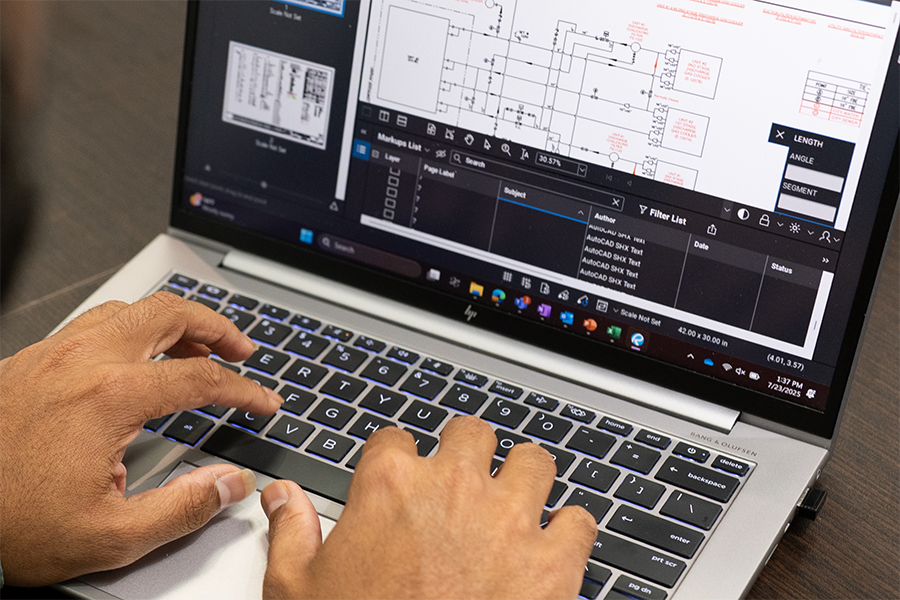
The adjustment was fast. “I started using it, and then I realized how easy it was to do a review with different disciplines,” she said. “You have your color code. You have your own column. You can see everybody’s comments. It makes it easier to understand who said what and when.”
Studio Sessions: The Global Review Command Center
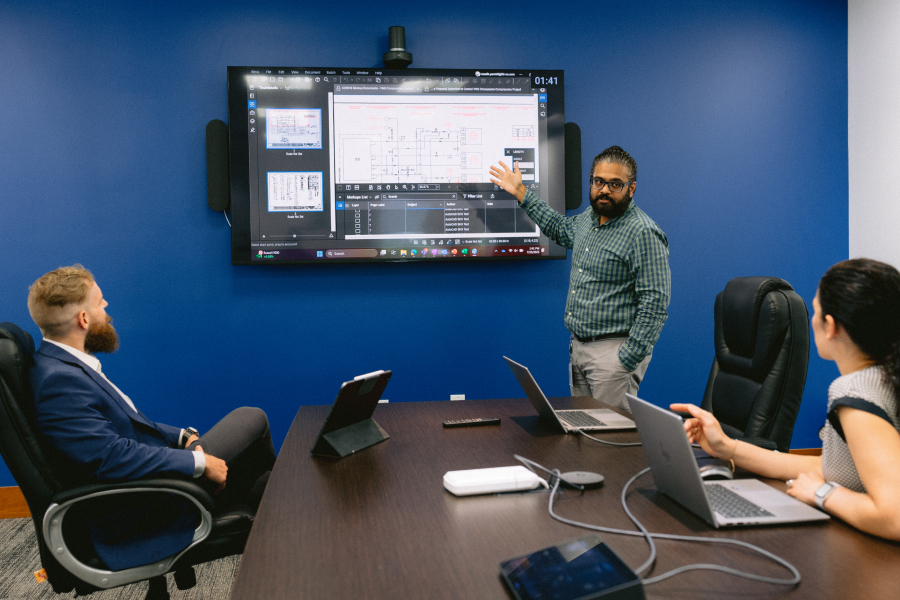
Today, Bluebeam Studio Sessions is the standard environment for all IES “Squad Checks.” Every stakeholder—from process engineers in Houston to clients in Tokyo and vendors across the U.S.—logs into the same digital Session for real-time collaboration.
“We have our clients in Tokyo, and we are in Houston,” Gomez said. “And we do have people from all over the U.S. as well, working remote.”
Each discipline at IES uses a unique color in Studio Sessions, providing visual clarity and clear accountability. “We try to keep it consistent,” Gomez said. “So, when someone’s reviewing something, you know exactly who said what.”
The result: A single source of information. “If it’s not in Bluebeam, it didn’t happen,” Goodrich said.
Even clients are taking notice. “They’re impressed by the fact that everything is tracked, and they can see who said what and what day,” Gomez said. “They like that transparency.”
Automation That Does the Heavy Lifting
What clients see on the surface is just one layer of the story. Behind the scenes, IES’s team has built a powerful automation system that creates Studio Sessions automatically using SharePoint and Power Automate.
“Bluebeam adds reviewers based on the file metadata,” Goodrich explained. “It populates the fields; it sets up the naming conventions. It also sends notifications out.”
What used to take 30 minutes or more per session now happens automatically, freeing up hours each week.
“That 30 minutes to an hour per session adds up quick,” Goodrich said. “That’s time we can now spend doing actual engineering work.”
But it’s not just about speed. “That kind of consistency makes it easier for people to focus on their discipline instead of the logistics,” Goodrich added.
“You have your color code. You have your own column. You can see everybody’s comments. So, it makes it easier to understand who said what.”
Carmen Gomez
Principal Process Engineer
IHI Energy Solutions
Design Tools, Reimagined
IES isn’t just using Bluebeam for review, but it’s become part of the design process itself. Especially for early-phase diagrams like PFDs and P&IDs, Bluebeam has replaced traditional tools.
“We used to do everything in AutoCAD,” Gomez said. “Now, we use Bluebeam.”
Gomez has created her own custom templates and tool sets to streamline this new design workflow. “I have my own templates and my own tool sets,” she said. “I started from scratch, just building things, like a library.”
These customized PDFs make it easier to create, revise and share diagrams with internal teams and external vendors. “It’s easier to use,” she said. “The markup tools are right there. We don’t need to export to another tool.”
Built for Growth, Not Burnout
Even with a smaller team, IES’s output hasn’t slowed. In fact, it’s picked up.
“Our workflows are scalable,” Goodrich said. “If we doubled in size tomorrow, it would still work.”
That’s because the company has invested in standardized, repeatable processes and a shared digital infrastructure that makes onboarding new employees and partners seamless.

What’s Next: Metadata, Tagging and AI Insight
Goodrich and his team are now exploring how to extract even more value from their workflows using metadata tagging and AI analysis.
The goal: to spot patterns, understand root causes and ultimately improve project outcomes through data-driven insight.
Culture of Efficiency
IES’s transformation isn’t just a story about adopting new software, but it’s a case study in cultural evolution—where people, process and platform are aligned around a single goal: working smarter, faster and more collaboratively across every project and stakeholder.
“We’ve learned to be really efficient with a small team,” Goodrich said. “Bluebeam is a big part of that.”
That efficiency isn’t theoretical, either. It’s playing out every day in faster review cycles, greater client satisfaction and a small team capable of producing the work of a much larger organization.