







Workplace design moves fast. Approvals stack up. Comments multiply. Suppliers wait. And if a single drawing goes out unclear the effects will be felt quickly, from pricing errors to installation errors on site.
For Oktra, keeping design reviews clean, controlled and accountable isn’t just about efficiency, but about protecting quality, cost and compliance across every project.
By standardising how drawings are reviewed, marked up and approved using Bluebeam, Oktra has built a process that reduces duplication, sharpens communication and gives every team — from cost managers to subcontractors — a single source of truth.
“We try to make sure that one complete markup serves every purpose,” said Jenny Edwards, a Creative Director at Oktra. “If we’re going to review something, we do it properly once, not three different times for three different audiences.”
That philosophy has reshaped how the firm handles drawing approvals across its business.

Oktra’s design team reviews material samples at the firm’s London studio. Every finish selection feeds into the drawing packages that designers mark up and approve in Bluebeam.
When Markups Multiply, Risk Follows
Oktra delivers workplace projects of varying sizes and duration, from fit-outs and refurbishments through to larger shell and core, or Cat A, schemes. Like many design-led businesses, the firm manages multiple live projects at once.
Each project involves layered feedback across internal design review, technical coordination, cost scrutiny, client approvals and supplier queries. While a typical drawing pack may run to around 60 drawings, that figure can easily exceed 100 once subcontractor drawings are included.
Without structure, that feedback can quickly exacerbate. Comments land in inboxes. PDFs circulate with unclear version control. Markups get redrawn for different teams. Instructions are repeated. And over time, ambiguity creeps in.
The risk isn’t just administrative.
At best, unclear reviews can introduce unforeseen costs. At worst, something moves forward that doesn’t align with the project’s design intent.
Traditional paper markups only compound the issue. Notes are crossed out and rewritten. Drawings are rescanned. Comments are reinterpreted for cost teams or subcontractors. Each redraw introduces potential error.
On fast-paced workplace projects — particularly those with tight client programmes — that margin for misinterpretation shrinks even further.
Oktra needed a way to centralise review feedback, eliminate duplication and maintain a clear audit trail — without slowing the pace of design.
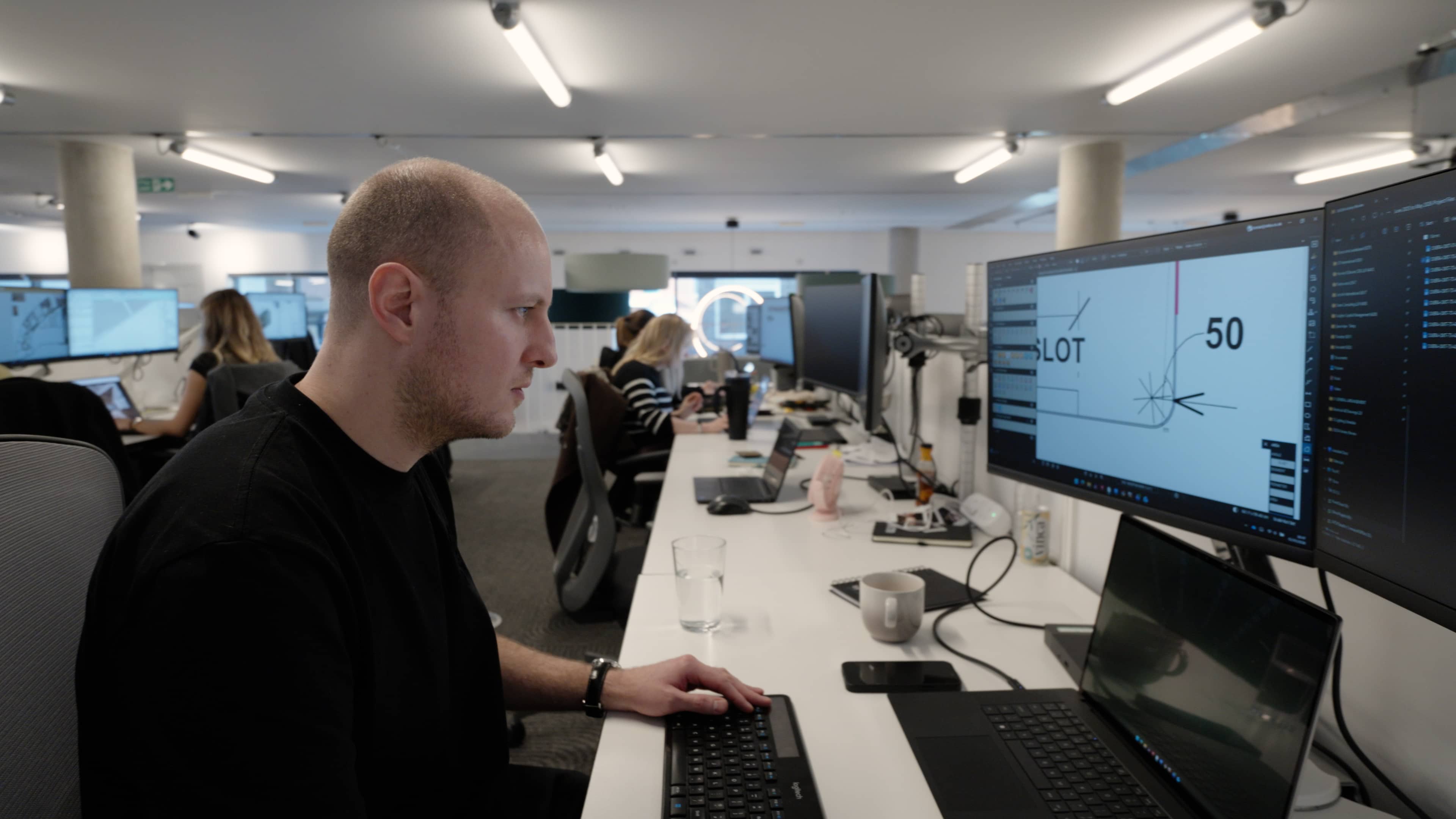
A senior designer at Oktra works through drawing details in Bluebeam. With multiple live projects running at once, the team relies on standardised markups to keep information clear across disciplines.
The Turning Point: One Complete Markup Set
Rather than treating each review as a separate exercise, Oktra made a deliberate shift: every drawing would receive one comprehensive markup set that could serve all downstream uses.
Design feedback. Technical coordination. Cost enquiries. Supplier instructions.
One review. One controlled document.
“It’s better to do one complete markup that serves all uses, rather than repeating it for each team,” Jenny said.
Using Bluebeam, designers create a consolidated markup layer that becomes the authoritative version. As designs evolve — whether adjusting finishes, ceiling layouts or joinery details — those markups are amended cleanly within the PDF rather than crossed out and recreated. On a typical project, that can mean working through around eight rounds of design review, with the same markup set carried forward each time.
That change alone improved the legibility and professionalism of issued drawing sets.
“I cannot imagine not having Bluebeam,” said Brad Smart, a Senior Designer at Oktra. “It has become an everyday part of our workflow.”
Instead of rescanning or rewriting comments, designers refine instructions directly in the document. Notes remain sharp, clear and traceable — even after several rounds of revision.
The result is fewer duplicated comments, clearer communication and less time spent reconciling conflicting versions.
Colour, Discipline and Accountability
Standardisation didn’t stop at consolidation. Oktra also formalised how markups appear.
Design disciplines use predefined colours to indicate perspective and responsibility. Custom approval stamps record who reviewed what, and when.
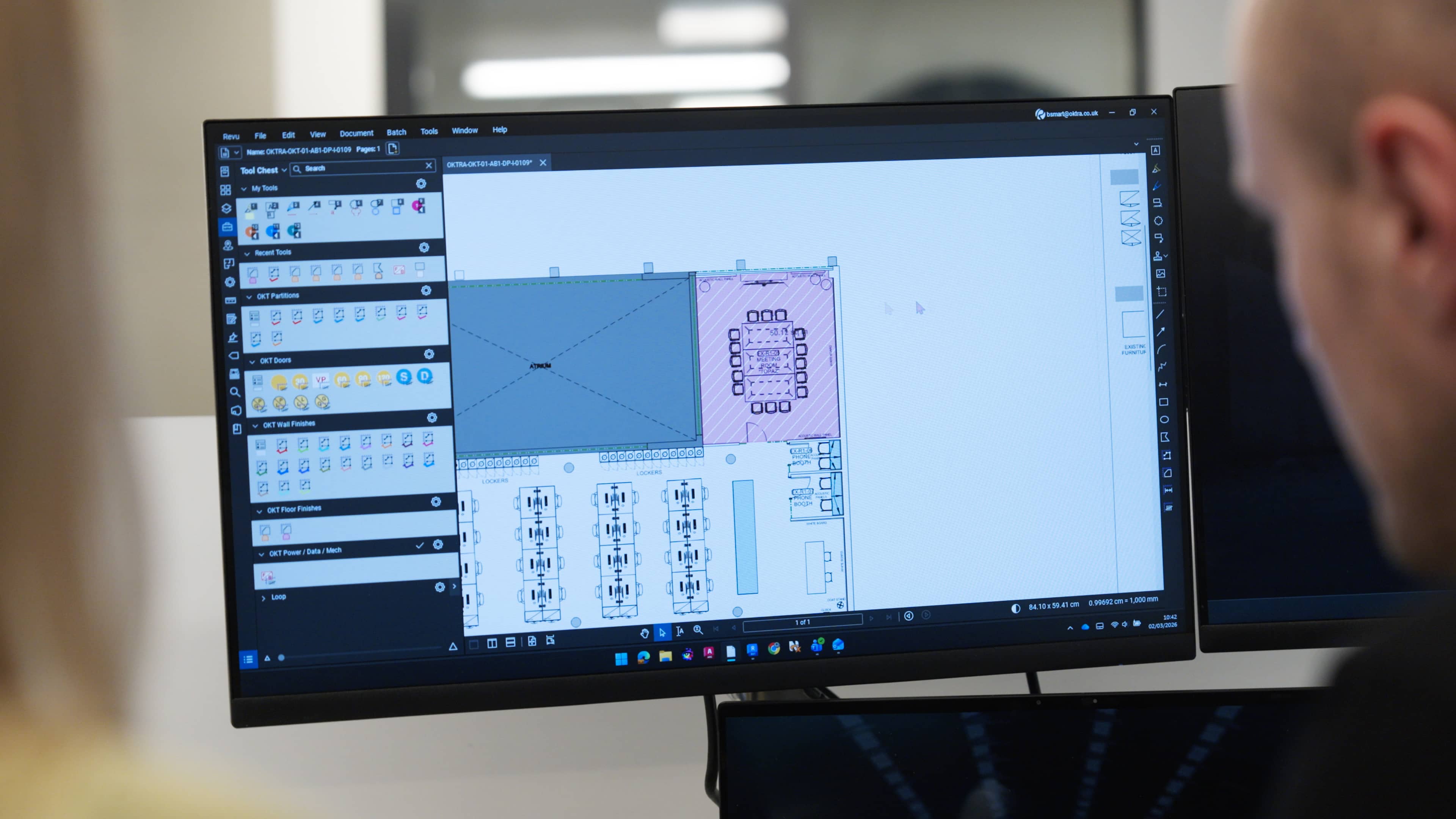
Oktra’s custom Tool Chest in Bluebeam organises markup tools by discipline, including partitions, doors, wall finishes, floor finishes and mechanical elements. The setup ensures every designer applies the same standards to drawing reviews.
“Internally and externally, I’ll use an approval stamp,” Brad explained. “For joinery and shop drawings, it shows I’ve reviewed the set and the date it was approved.”
That timestamp does more than tidy up the document. It creates accountability.
When drawing packages are issued to clients or subcontractors, Oktra retains a saved copy of the marked-up PDF in a controlled folder structure.
While clarification queries are rare, if something has not materialised on site as expected, the team can refer back to the exact markup and approval date when challenging the relevant subcontractor.
For cost managers preparing enquiries, clarity matters. Quantities and finishes are explicit. Adjustments are visible. Assumptions are minimised.
This reduces ambiguity before pricing even begins.
Structured Client Reviews with Studio
Client feedback introduces another layer of complexity — especially across multiple stakeholders and time zones.
To bring structure to that stage, Oktra uses Bluebeam Studio Sessions to host time-bound, colour-controlled review sessions.
The team uploads the drawing set, defines the review window and asks clients to use a designated markup colour. Comments are centralised, date-stamped and attributed.
“Studio gave us a clear line in the sand,” Brad said. “We could see every comment, by colour and date, before we did the page-turn.”
Instead of compiling scattered emails ahead of meetings, the team enters page-turn reviews with a consolidated record.
For international programmes — particularly those with limited client availability — this can reduce travel pressures and accelerates decisions.
By assigning colours and roles in advance, Oktra also reduces duplicated comments during client reviews. Only agreed changes move forward into the next revision.
Integrating the Right Tools for the Right Stage
As projects transition from early design to live technical coordination, Oktra integrates additional platforms into its workflow.
For daily multi-disciplinary collaboration, Autodesk Construction Cloud’s markup tools help centralise coordination across consultants.
Bluebeam, to be sure, remains the tool of choice for designer-led instruction, particularly when issuing information externally to suppliers.
For example, when reviewing joinery or specialist packages, designers may sketch directly on an iPad within Bluebeam, add dimensions and annotate precisely what needs pricing.
That mix allows Oktra to maintain efficiency internally while ensuring external communication remains clear and controlled.
“Technology works best when you can find the best tool for the task at hand, and then easily integrate it throughout your workflow,” Jenny said.
The common denominator remains standardisation.
Cultural Shift: From Red Pen to Digital Discipline
Beyond workflow improvements, the shift to structured digital markups has influenced team culture.
Bluebeam has become a staple tool for the design team. New designers are given basic training to ensure they have a solid foundation, allowing them to expand their use of Bluebeam over time to benefit their projects.
Designers are trained to think about clarity at the point of review, not after confusion arises.
Instead of relying on verbal explanations or follow-up emails, instructions are documented within the drawing itself.
The process reduces reliance on individual memory. It embeds consistency into the document.
Over time, that consistency compounds.
Fewer duplicated markups. Fewer reissued drawing sets. Fewer clarification loops.
While Oktra doesn’t currently quantify time savings, the team describes the system as essential to day-to-day approvals and pre-construction coordination.
“It is simply faster and more precise for drawing review than a general PDF reader,” Brad said.
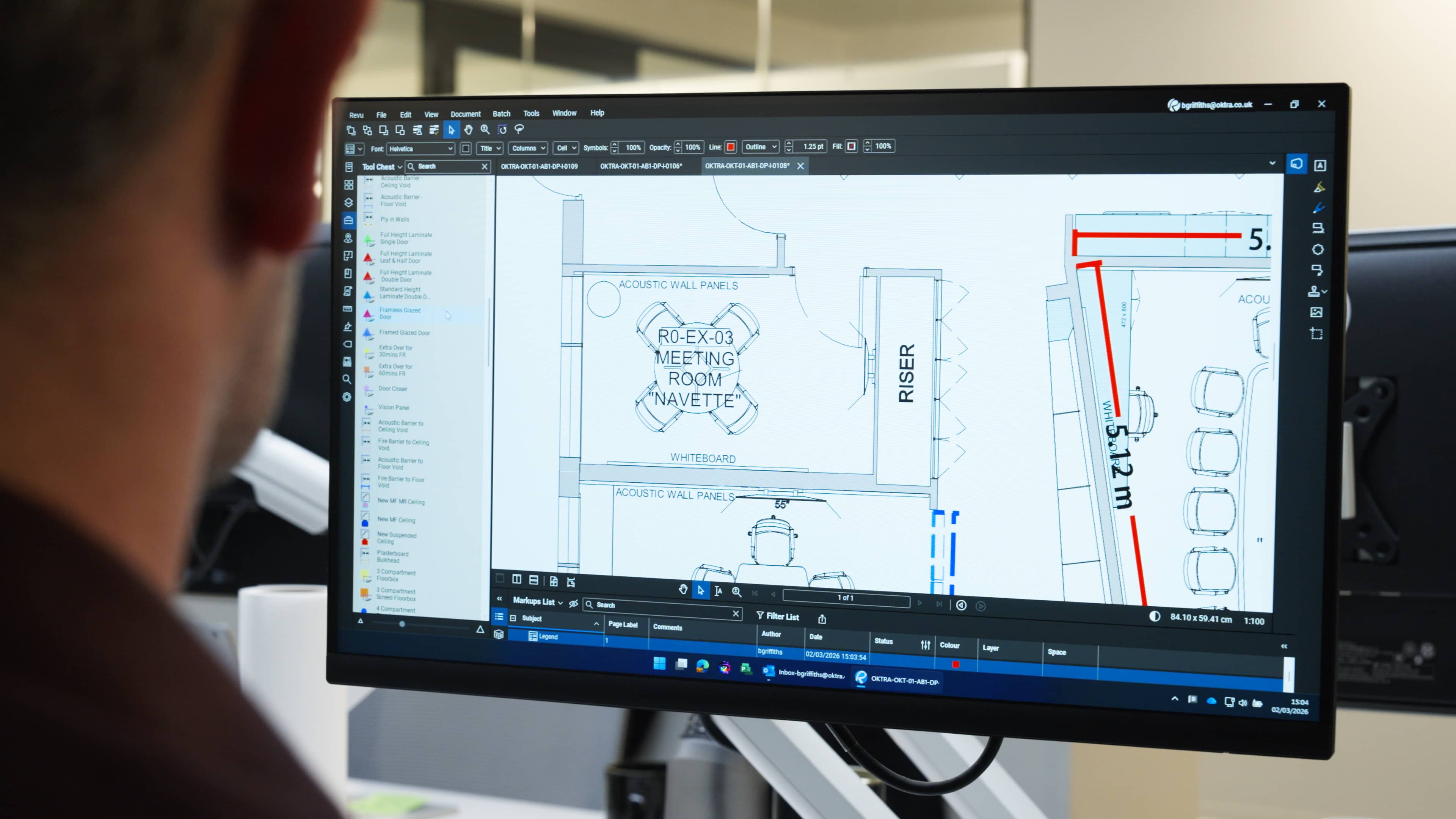
A detailed meeting room layout in Bluebeam, with red markup measurements and a Markups List tracking author, date and approval status. This level of precision in the drawing review is what allows Oktra to issue clean packages to subcontractors.
Reducing Risk Before It Reaches Site
In workplace fit-out projects, design intent can shift rapidly, especially when clients adjust layouts, finishes or furniture packages midstream.
When those changes aren’t captured cleanly, cost exposure increases.
By maintaining a controlled markup history, Oktra reduces the risk of something being priced, fabricated or installed incorrectly. In turn, rework and site clarifications have reduced, as subcontractors receive clearer instructions from the outset.
Quantities and finishes remain adjustable at design stage. Cost managers can review options without guessing which version is correct.
The impact may not appear in a single metric, but it shows up in smoother coordination and more confident issuance of information.
Building a Foundation for Growth
Standardised design reviews aren’t flashy and don’t generate headlines, but for a firm managing complex workplace transformations, they create operational stability.
Oktra has taken on increasingly complex schemes over the past five years, with greater demands around sustainability, safety and BIM deliverables. As project requirements increase, the discipline around markups has allowed teams to scale without losing clarity.
The growth is reflected internally. The business began with around 30 Bluebeam users, but in the past year alone, that number has more than doubled to nearly 70.
Each project begins with the same expectation: one comprehensive markup set. Clear accountability. Structured reviews.
The process protects design integrity while accelerating collaboration.
For Jenny, the value is simple.
“If we’re issuing drawings, they need to be clear,” she said. “We want everyone — cost teams, technical teams, suppliers — to be working from the same understanding.”
That understanding now lives in a single, controlled document.
And in a business where details drive outcomes, that clarity makes all the difference.